
Key Takeaways
- Mobilization Speed: Accessing upfront capital allows crews to be on-site and working immediately after receiving a notice to proceed, rather than waiting for initial mobilization draws.
- PO Capacity: Increases the ability to fulfill large-scale purchase orders by covering the gap between ordering materials and receiving final project payments.
- Tax and Payroll Compliance: Provides the liquidity needed to cover 941 payroll taxes and weekly labor costs, helping the business stay compliant while keeping the workforce stable.
- Revolving Capital: A revolving structure means that as draws are paid down from completed milestones, the capital becomes available again for the next project or purchase order.
Upfront Costs for Purchase Orders and Job Mobilization
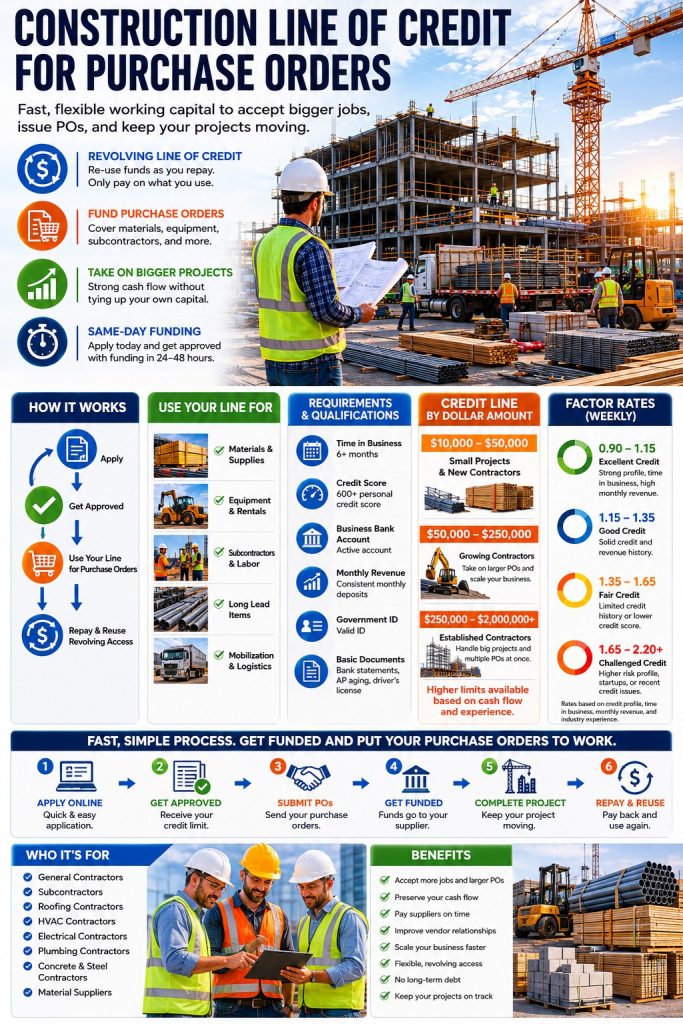
A construction business line of credit for purchase orders and job mobilization allows contractors to cover upfront expenses to complete projects related to purchase orders. Large commercial and government jobs require that contractors cover costs such as materials and payroll to keep crews mobilized and working. Access to a fast, unsecured working capital credit line ensures your business has the resources it needs to make these purchases without draining your bank account.
Revolving Flexibility for Ongoing Project Funding
A revolving line of credit for construction company purchase orders provides flexible funding that can be used over and over. Contractors can draw funds as needed, repay the loans, and draw all over again. This type of flexibility provides your business with the capital needed for any expenses, such as payroll, 941 payroll taxes, materials, equipment rental, or anything else needed to complete projects issued with purchase orders. An unsecured construction business purchase order credit line allows your business to take on larger contracts and keep your projects funded without delays while waiting on customer payments.
Real-World Perspective From a Contractor
As a business owner, I understand the importance of having access to working capital when you need it. Growing your construction business is never without cash flow issues. I wrote this guide so you can learn how a revenue-based line of credit for purchase orders is structured. You will learn the difference between secured and unsecured credit lines and underwriting requirements, as well as the qualifications needed to apply for a construction business line of credit for purchase orders.
Revenue-Based Underwriting for Construction Line of Credit for Purchase Orders
Key Takeaways
- Performance Over History: Underwriting focuses on actual cash flow from the last 90 to 120 days rather than years of historical tax returns or audited financials.
- Deposit Strength: Total gross volume and the frequency of monthly deposits are the primary metrics used to determine borrowing capacity.
- Real-Time Analysis: Lenders use the most recent bank statements to conduct a live evaluation of business health, allowing for approvals in hours rather than weeks.
- Revolving Accessibility: Because these lines are not bound by traditional banking constraints, contractors can access capital for purchase orders without the extensive paperwork required by SBA financing.
How Lenders Evaluate Your Revenue
A revenue-based line of credit for purchase orders is approved based primarily on the stability of your cash flow. Underwriters will look at the last 3 to 4 months of business bank statements to determine your eligibility. Underwriting will analyze the last 4 months for borrowers in New York and California to comply with state regulations. They look at factors such as your gross monthly revenue, frequency of deposits, and the overall stability of your cash flow. Lenders are able to make a real-time analysis of your business through your business bank statements.
Why Strong Deposits Drive Higher Approvals
Your approval is based on the average of your last 3 to 4 months of deposits, depending on where you live. Your gross monthly deposits determine your approval limit. The more you deposit monthly, the higher the approval amounts you will be able to unlock. Regular, consistent revenue each month shows that your business is stable and generating revenue on a regular basis.
Flexible Alternative to Bank Underwriting
Traditional bank and SBA loans rely on extensive documentation to determine your eligibility. You will need to submit documents such as 2 years of personal and business tax returns, 2 years of business and personal bank statements, as well as audited financial reports. On the other hand, alternative lenders offer a more streamlined approach by only requiring that you submit a signed credit application and business bank statements.
Secured vs Unsecured Construction Line of Credit for Purchase Orders
Key Takeaways
- Collateral Requirement: Secured lines require pledging high-value assets like real estate or heavy equipment, while unsecured lines are based entirely on 90-day revenue performance.
- Funding Velocity: Unsecured lines bypass the lengthy appraisal process, offering access to capital in 24 to 48 hours compared to the weeks or months required for secured bank products.
- Documentation Burdens: Secured funding requires years of tax returns and audited financials, while unsecured lines under $150,000 typically only require a one-page application and recent bank statements.
- Risk Profile: While secured lines offer lower rates, they put personal or business assets at risk of seizure. Unsecured lines carry higher costs but protect physical property from default.
Secured Line of Credit for Purchase Orders and Job Mobilization
A secured construction line of credit for purchase orders requires that you pledge collateral such as real estate or heavy-equipment equity. A secured credit line offers the best interest rates as opposed to an unsecured line of credit. Borrowing costs are minimized due to the collateral that acts as a safety guard in the event that your business defaults on the loan. Banks will typically lend 80% LTV for real estate and much less for heavy-equipment. Borrowers who have access to collateral will get the best terms as well. Banks will lend for multiple years so long as they have a safety net.
Secured lines do require time to get approved and set up. You will need to submit all the required documents such as tax returns and financial reports. An appraisal of your assets will also be required. This can take several weeks or months if you are pledging real estate. The biggest drawback is that you risk losing your assets in the event of a default. It is never recommended to use your home to finance a business venture.
Unsecured Line of Credit for Purchase Orders and Job Mobilization
An unsecured construction purchase order credit line does not require that you pledge any collateral. Alternative lenders are not regulated by the same guidelines as traditional banks or the SBA. Underwriters focus on your revenue and your most recent gross bank deposits to determine your eligibility. This type of flexibility allows for a much faster approval with funding available in 24 to 48 hours or less.
An unsecured line of credit for purchase orders requires minimal documentation such as a signed and completed credit application and your most recent business bank statements. The cost of an unsecured credit line is higher, although the speed and flexibility does justify the additional costs so long as you use the funds as a means to achieve a return on investment.

Construction Line of Credit for Purchase Orders Requirements and Qualifications
Key Takeaways
- Revenue Threshold: A baseline of $15,000 in monthly gross deposits is required to establish the borrowing base, with approval limits typically matching average monthly revenue.
- Deposit Diversity: Lenders require a minimum of five deposits per month to prove revenue comes from multiple sources, reducing the risk associated with single-customer reliance.
- Banking Hygiene: Maintaining a positive daily balance and keeping NSF activity under five charges per month is critical for securing higher approval amounts and lower factor rates.
- Debt Capacity: While multiple loan positions are allowed, total outstanding debt must remain below average monthly revenue to avoid being classified as overleveraged.
Revenue Requirements and Approval Amount
When applying for a contractor’s payroll line of credit, underwriters mainly look at revenue. A minimum of $15,000 per month in gross deposits over the previous three to four months would be needed in order to even be considered. In the states of New York and California, underwriters look at the last four months of deposits.
Based on these deposits, your credit line can then be determined, unless you have any other outstanding loans. The example below should help you visualize the process:
- Month 1: $83,000
- Month 2: $76,000
- Month 3: $89,000
- Average: $82,000
Your approval would depend on outstanding liabilities and your banking activity, but would usually be around $82,000 or less. When you have low NSF activity, consistent deposits, and high average balances, you are more likely to get the highest approval amount. However, other active loans or positions will be subtracted from the average in order to finalize an amount. If your revenue can support the other payments, then other positions or loans should not be a problem.
Deposit Frequency
The term deposit frequency regards the amount of deposits you get from customers per month. You would have to get at least five deposits a month to be eligible. The more deposits you have, the more diversified your customer base looks. Without the minimum of five deposits a month you are at risk of being denied. The benefit of having a lot of activity is that your business appears to generate revenue consistently and is not just relying on a couple of payments a month.
Banking Activity Requirements
Activity in your bank statements is also something that underwriters look at. Having high average daily balances shows underwriters that you can handle your company’s revenue. Your NSF activity should be kept to a minimum and it is important to also have high beginning and ending balances. You should only have a maximum of five NSF charges for the best rates. It is common for a lot of NSF charges to result in denial or at least result in higher factor rates. The cleaner your banking activity appears, the more likely you are to be approved with lower finance charges.
Time in Business
At least six months of being in business is required to be eligible. However, you will normally qualify for better programs with better limits and greater terms when you have been in business for two or more years. The longer you are in business diminishes your risk profile. This then demonstrates to underwriters that you are able to finish projects while dealing with delays and market fluctuations.
Credit Requirements
A credit score of at least 550 is needed to apply for a payroll working capital line of credit. A higher credit score of at least 600 or better will allow you to apply for better programs. Although underwriters mostly look at your revenue, your score can still affect the cost. A bad credit score won’t disqualify you, but you will have bigger rates. Higher credit scores allow you to get lower finance costs as well as longer terms and bigger approval amounts.
Existing Loans or Positions
Existing loans or positions do not disqualify you from applying for a payroll line of credit. You are, however, limited to the amount your business creates in revenue. While certain programs only allow you to have a maximum of two positions, you can still apply for others. It is important to remember that you assume more risk with additional positions. This would then inflate your borrowing costs.
Factor Rates, Payment Terms, and Repayment Frequency for Purchase Order Credit Lines
Key Takeaways
- Fixed Cost Capital: Factor rates provide a transparent upfront cost calculation, allowing contractors to build the exact expense of capital into project bids.
- Performance-Based Pricing: Rates are driven by banking stability, with high daily balances and clean NSF history directly supporting lower multipliers.
- Customized Durations: Terms range from 3 to 24 months, giving contractors flexibility to align repayment schedules with expected purchase order payouts.
- Cash-Flow Matching: Payment frequency, including daily, weekly, or monthly options, is tailored to the revenue cycle to help prevent debt service from straining operational liquidity.
Factor Rates for Purchase Order Credit Lines
Alternative lenders do not calculate finance charges the same way as traditional lenders such as banks or the SBA. Alternative lenders charge a factor rate, which is based on a straight integer-based calculation that uses a “multiplier” against the specific loan amount. Traditional loans charge interest that accrues either daily or monthly on any unpaid balances.
Factor rates for a contractor’s purchase order line of credit range from 1.20 to 1.45. This depends on a variety of factors related to your business profile. Underwriters look at your revenue and the stability of your cash flow to make that determination. Businesses with strong revenue, positive daily balances, and strong beginning and ending balances with limited NSF activity are more likely to qualify for a lower factor rate. Higher-risk borrowers with lower credit scores and marginal cash flow will qualify for a higher rate. You will need to multiply the loan amount by the multiplier in order to determine your overall costs.
Example:
$100,000 X 1.33 (factor rate) = $133,000 total payback
Payment Terms for Purchase Order Funding
Your payment term refers to the number of payments that you will make. Terms range from 3 to 24 months depending on approval. Longer terms have a lower payment; however, total finance charges are going to be greater. Shorter terms have higher payments with lower borrowing costs. Your term is going to be based on your payment frequency. It is expressed in either days, weeks, or months, depending on your approval. To calculate your payment, take the total costs of borrowing and divide by the number of payments.
Example: $100,000 X 1.33 (factor rate) = $133,000 / 46 weekly payments = $2,891
Repayment Frequency Based on Cash Flow
Your repayment frequency is determined by how often you will make your payment. Terms are approved on an individual basis. You will qualify for either a daily, weekly, or monthly payment depending on your business profile. Businesses with less than perfect cash flow will more than likely qualify for a daily payment. Those with good cash flow should qualify for weekly payments. A monthly payment requires very good credit and strong cash flow to qualify.
Common Reasons Construction Line of Credit for Purchase Orders Are Denied
Key Takeaways
- DataMerch Tracking: Alternative lenders use a centralized database called DataMerch to track defaults, with records tied to both personal Social Security numbers and Federal EINs.
- Modification Red Flags: Any deviation from an original repayment plan, even a negotiated payment arrangement, can be flagged as a modification and signal cash-flow instability to underwriters.
- Entity-Wide Accountability: Defaults or modifications associated with a partner or previous business ownership can still result in a denial for the current company.
- The Starter Exception: In rare cases, a past default may not cause a flat denial, but it can result in a starter loan with a high 1.45+ factor rate and a short 30-day term to prove repayment reliability.
Defaults Identified Through DataMerch
One of the most common reasons for denial we see is that a borrower has had a past default with another alternative lender. Underwriters will always check your borrowing history at some point during the pre approval or final underwriting stage of the process. Lenders will use DataMerch, an online resource that tracks this sort of data. Your lending history is tied to your social security number as well as your Federal EIN. A prior default with another business owned by you or with a partner will be tracked by DataMerch. Defaults result in non approval or in few cases a short term 30 day with 1.45 or higher factor rate.
Payment Modifications and Increased Risk
Payment modifications are another reason that underwriters deny borrowers. Any payment arrangements that you have made with another lender are considered to be payment modifications. Underwriters view this as a red flag due to cash flow struggles which may impact your ability to meet future obligations. This signals higher risk and can significantly reduce your chances of approval or result in higher factor rates and stricter terms.
Bad Credit Construction Line of Credit for Purchase Orders (Fast Approval Options)
Key Takeaways
- Performance-Based Entry: Contractors can qualify with a FICO score as low as 550 because underwriting prioritizes the last 90 days of revenue over historical credit challenges.
- Banking Stability: High daily balances and minimal NSF activity can offset a low credit score by showing lenders current liquidity to support repayment.
- Tiered Pricing: While bad credit is not always a dealbreaker, it does impact cost, with higher factor rates and daily repayment structures common for scores in the 550 to 600 range.
- Path to Improvement: Establishing a positive track record with a starter line can help contractors move toward better programs, lower rates, and weekly payment options as credit score or revenue improves.
Can Contractors Qualify With Bad Credit?
You can still apply for a construction line of credit for purchase orders with a FICO score as low as 550. Unsecured credit lines for contractor purchase orders are based on revenue as well as your overall banking activity vs. your credit score. Maintaining strong, consistent revenue each month and maintaining positive daily balances with minimal NSF activity signals proper cash flow management. Lenders focus on your current ability to repay the loan rather than past credit issues.
How Bad Credit Affects Terms
Bad credit does not affect your ability to apply for a construction company line of credit for purchase orders. FICO scores between 550 and 600 are still eligible for consideration. However, borrowers with credit scores in this range pay higher factor rates and receive less favorable terms. Lower-credit-tier borrowers may also be approved for daily payments as opposed to weekly. Fair credit borrowers whose FICO scores fall between 600 and 650 will qualify for better programs with improved rates and terms. Those with fair to good credit will also have a greater chance of qualifying for a weekly payment.
How to Apply for Construction Line of Credit for Purchase Orders Same Day Funding
Key Takeaways
- Documentation Readiness: Having the last 4 months of business bank statements and a voided check ready can reduce approval time to under two hours.
- Digital Verification: DecisionLogic is a mandatory security step that allows underwriters to verify day-of bank balance and revenue consistency.
- Funding Deadlines: To receive a same-day wire transfer, all steps, including the merchant interview, must be completed before the 4:00 PM ET banking cutoff.
- Purpose Compliance: Capital is strictly for business use, so the merchant interview should clearly explain how funds will support projects or purchase orders.
Submit Credit Application
An online credit application is needed for contractors to apply for a construction business line of credit. The form asks for simple information like your first and last name as well as the name of your business. Other details needed include your phone number, how long you’ve been in business, your personal details, and business details.
Submit Business Bank Statements
Through the online application, you would then submit bank statements for the previous three to four months. Borrowers in the states of New York and California must submit the previous four months per state regulations. Statements from programs like Stripe or PayPal will not be accepted. A business bank account is required to be eligible for approval.
Receive Pre-Approval Offer
After a few hours, you should receive a pre-approval offer; however, that does vary depending on how complex your file is. This pre-approval offer will allow you to visualize your loan amount, factor rate, and payment frequency. With this information, you can then calculate your costs and figure out your return on investment. You will also be notified if your application did not meet the qualifications. Once rejected, you can re-apply in three months.
Sign Documents
After you accept the offer, your loan documents will be sent. The documents will need to be signed, and this can be done using an online platform like DocuSign. You will also have to provide a copy of your state-issued driver’s license as well as a voided check. It is also possible you will be asked to submit documents like your state Articles of Incorporation or your IRS Form 1040.
Final Underwriting Review
Once all documents have been received, your file will be moved into final underwriting. This includes a detailed investigation of your business and banking activity. The process involves looking into past payment history with unsecured lenders through DataMerch. This is an online resource that allows underwriters to view this history and is a standard credit rating program within the industry.
The process also requires you to use DecisionLogic to link your bank account. DecisionLogic is a tool that helps with bank verification by letting the underwriter look at the current month’s banking activity in real-time. The underwriting process ensures that your revenue is uniform compared to previous months and identifies any other unsecured loans that you may have but did not add to your file. If undisclosed loans are found, it could result in denial or a higher price on your current offer. Your bank account must also be positive and have enough liquidity to cover three payments.
Merchant Interview
Before final funding, a merchant interview is required. This is when the underwriter asks questions about the use of your funds. This is to ensure that you do not use the contractor’s credit line for any personal reasons. Stating that you intend to do so will result in an immediate denial. This is a short interview which normally only takes five to ten minutes.
Final Funding
Once you pass the merchant interview, your final funding will be sent that same day. The funding will be sent through a same-day wire transfer, and you should receive it that day provided the transfer is made before the 4:00 PM ET cutoff. If the wire is sent after that time, it will arrive the following day. Any ACH transfers usually take about twenty-four to forty-eight hours to be visible in your account.

Trades That Use Construction Line of Credit for Purchase Orders & Job Mobilization
Key Takeaways
- Bridging the Payment Gap: Most trades deal with Net 30 to 90 payment terms, and a line of credit helps prevent contractors from funding the developer’s project with personal savings.
- Large-Scale Procurement: Specialized trades like electrical and HVAC can use credit to buy high-ticket components, such as copper or industrial units, without maxing out credit cards.
- Payroll Continuity: Labor is one of the most frequent and non-negotiable expenses for any trade, and these lines help prevent missed Friday payroll while waiting for a draw.
- Bidding Capacity: Having an open line of credit allows contractors to bid on larger commercial or government contracts they may have previously turned down due to upfront cost requirements.
General Contractors
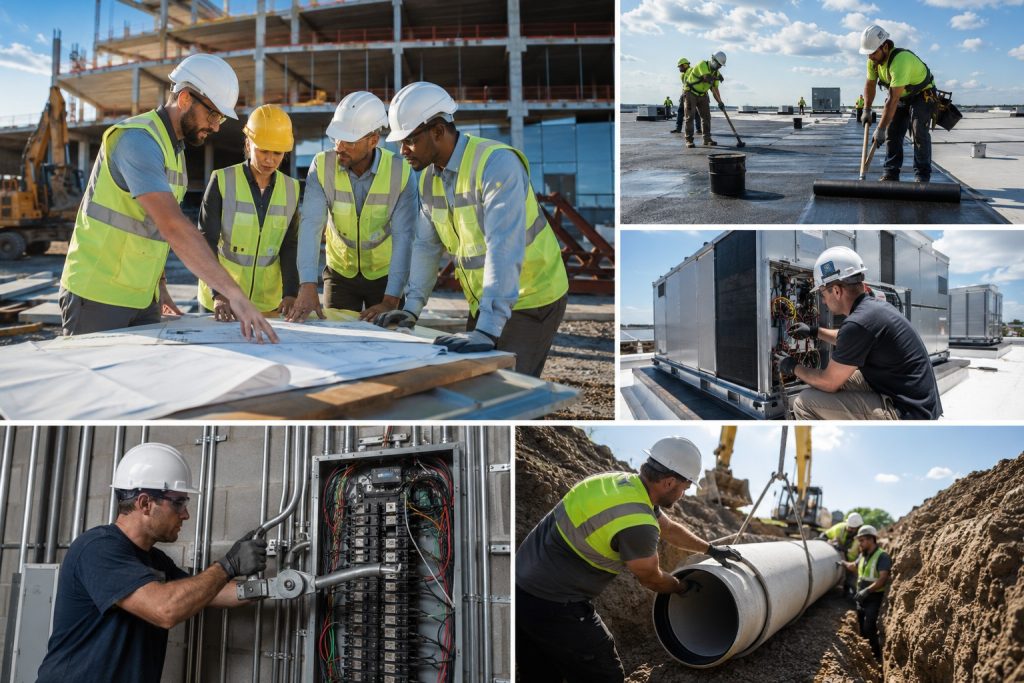
General contractors use a construction line of credit for purchase orders to fund large projects. Large commercial projects require contractors to make upfront purchases for materials and payroll while waiting Net 30, 60, or 90 days to get paid. These delays in cash flow can cause issues with operations. A contractor’s credit line for purchase orders can help bridge the gap between outgoing expenses and customer payments.
Roofing Contractors
A roofing contractor can rely on a credit line for purchase orders to respond to insurance claims related to a large hail storm. Insurance companies pay in a multi-stage process that takes time. You can use a construction purchase order credit line to cover expenses such as payroll and materials while waiting for those payments.
HVAC Contractors
HVAC contractors can use a working capital credit line for purchase orders to pay for expenses related to large commercial jobs. General contractors often issue HVAC contractors a purchase order to complete a large job. These types of jobs may require the upfront purchase of expensive commercial HVAC equipment. Apply for an HVAC contractor’s credit line for purchase orders to cover these expenses.
Electrical Contractors
Electrical contractors who want to take on large commercial projects are often required to work with purchase orders. These jobs may require the purchase of hundreds of feet or more of copper wire, electrical panels, switches, and labor to install everything, only to be paid when the building receives a Certificate of Occupancy. Apply for an electrical contractor’s credit line for purchase orders to cover these expenses until you get paid.
Plumbing Contractors
Plumbing contractors, like other subcontractors, must work with purchase orders in order to bid on large commercial or government projects. These jobs require your company to make large purchases for materials and cover payroll for months until the job is complete. Apply for a plumbing contractor’s credit line for purchase orders to cover these expenses while you wait for payment.
Landscaping Contractors
Landscaping contractors need to hire crews, rent equipment, and buy materials to complete large purchase orders issued by general contractors. These types of projects require large working capital to execute and complete in a timely manner. Apply for a landscaping contractor’s working capital line for purchase orders to keep crews paid and jobs moving forward timely.
Construction Line of Credit for Purchase Orders by Dollar Amount
Key Takeaways
- Revenue Matching: Approval limits typically mirror monthly gross deposits. If a contractor averages $50,000 in monthly revenue, they can generally qualify for a $50,000 line.
- The $150,000 Cutoff: Credit lines under $150,000 are usually approved using only bank statements. Above $150,000, lenders often require tax returns to verify business income.
- No Collateral Needed: Contractors can qualify for up to $250,000 in working capital without pledging real estate or equipment, provided cash flow is stable.
- Large-Scale Operations: High-limit lines over $250,000 are intended for contractors managing multiple crews or high-value government and commercial contracts.
$25,000 Construction Line of Credit for Purchase Orders
A $25,000 credit line for purchase orders is for contractors who generate at least $25,000 per month in revenue. Your approval is tied to the average of the last 3 to 4 months of gross deposits. This level of revenue will help unlock credit lines starting at $25,000. The more you deposit each month, the higher your credit line will be.
$50,000 Construction Line of Credit for Purchase Orders
A $50,000 credit line requires you to have at least $50,000 in gross monthly deposits over the last 3 to 4 months. This funding is used to cover purchase order expenses such as materials and mobilization costs needed to start a project.
$100,000 Line of Credit for Construction Purchase Orders
A $100,000 credit line requires at least $100,000 in monthly revenue. Small to medium-sized contractors often hit this level of deposits. A $100,000 credit line gives your business the liquidity needed to take on larger projects without running out of cash before the first draw.
$250,000+ High-Limit Construction Line of Credit for Purchase Orders
Contractors with more than $250,000 in gross monthly revenue can apply for lines of $250,000 and up. This capital is used for large-scale commercial or government projects. This level of funding allows you to manage multiple crews and keep your projects on schedule.
$500,000+ Ultra-High-Limit Construction Credit Line for Purchase Orders
Built for commercial firms clearing $500K+ monthly. This elite tier provides the heavy capital needed to fund large material outlays, backstop massive mobilization costs, and take on major bids without tapping your cash reserves. Check your eligibility for our premium $500K contractor working capital loans.
Frequently Asked Questions (FAQ)
What is a construction line of credit for purchase orders?
A contractor’s line of credit for purchase orders is a revolving financial solution that allows you to draw funds, pay down loans, and draw again as your credit amount is replenished. This product works very similar to a credit card, with the exception that you are given cash.
How do I qualify for a purchase order line of credit?
You will need at least $15,000 per month in monthly revenue over the last 3 to 4 months deposited into your business bank account. You will also need to meet minimum underwriting guidelines such as a 550 FICO score.
How much can I get approved for?
Your approval is based on the average of your last 3 to 4 months’ gross deposits, less any other unsecured loans that you may have. Underwriters focus on the last 4 months for borrowers in NY and CA.
Can I get approved with bad credit?
You can be approved with a FICO score as low as 550. Underwriters focus more on your revenue vs. your credit score. You can still be approved so long as your revenue will support the payment.
How fast can I get funded?
You can get pre-approved in as little as 4 hours and funded the same day. Most funding happens within 24 to 48 hours after submitting your signed credit application and your business bank statements.
Do I need collateral to qualify?
You do not need any collateral to qualify for an unsecured construction line of credit. You will need to give your personal guarantee, as you do with any business credit card.
What can I use the funds for?
You can use the funds for any business-related purchases such as payroll, equipment rental, materials, workers’ compensation, or any other expenses related to your business. You cannot use the funds for any personal reasons.
What are typical rates and terms?
Factor rates typically range from 1.20 to 1.45 or higher, depending on your creditworthiness as well as the cash flow of your business. Terms range from 3 to 24 months, and payment frequency varies from daily, weekly, or monthly depending on your risk profile.
Why do applications get denied?
The most common reasons include past defaults reported through DataMerch. Other factors include excessive NSF activity, inconsistent revenue, low deposit frequency, or prior payment modifications that signal cash flow issues.