
Key Takeaways
- Friday Payroll Reliability: Bridge the gap between net-30/90 commercial receivables and immediate Friday payroll/941 tax deadlines.
- Mobilization Capital: Secure the “money to make money” required to float labor and materials for lucrative commercial contracts.
- Rapid Cash Infusion: Access liquidity in 24 to 48 hours to handle equipment rentals or urgent fleet maintenance without pledging collateral.
Cash-Flow Pressures in Residential Landscaping Operations
Running a residential and commercial landscaping company is a cash-intensive business that requires constant liquidity to keep up with daily expenses. Payroll, 941 payroll taxes, insurance, and fleet maintenance will eat up your cash flow very quickly. Every Friday workers expect to get paid, while payroll taxes are due monthly. Workers’ compensation payments are also due, all while having to keep up with expenses such as equipment rental to keep crews working.
Why Commercial Landscaping Jobs Create Working-Capital Gaps
Commercial landscaping company owners face even more challenges. Commercial jobs are very lucrative, but most pay net 30, 60, or even 90 days. Landscaping contractors are left looking for working capital to service commercial work as well as what is in the pipeline. The bottom line is that it takes money to make money. An unsecured loan for a landscaping company can help you raise money and cover these expenses and others when needed.
What This Guide Will Teach Landscaping Business Owners
As a former business owner, I understand how heavy the pressures of payroll and other expenses can be. In this guide, I will explain how to get a fast cash infusion when you need it. You will learn how unsecured loans for landscaping companies are structured and what lenders typically look for during underwriting. I will also explain how credit and revenue impact your approval, and how to use this type of financing responsibly.
What an Unsecured Loan for Landscaping Company Operations Is Used For
Key Takeaways
- Operational Continuity: Prevent disruptions by covering payroll taxes and hiring additional crews before penalties or project delays occur.
- Workload Spike Readiness: Use short-term funds to rent specialized heavy equipment, like excavators, only when the current job demands it.
- Marketing for Growth: Absorb the high upfront cost of 2026 lead generation ($110/lead avg) to consistently fill your sales pipeline.
Covering Payroll Gaps and Operating Expenses
An unsecured loan for a landscaping company can be used for a variety of purposes. The primary purpose is to close the gap between payments and expenses. Sometimes payments don’t arrive when expected which can disrupt operations. Use this type of loan to cover payroll or payroll taxes before penalties kick in. You can also use this type of short-term working capital to hire additional crews for taking on new jobs. In all, you can keep your crews happy while your projects move forward.
Short-Term Equipment Rentals During Workload Spikes
Most landscaping contractors purchase heavy-equipment, such as excavators for removing tree stumps. However, there are times when equipment on hand is not enough to complete your workload. In cases like these, you can use an unsecured loan for short-term equipment rental when workloads spike.
Using Unsecured Capital to Fund Marketing Campaigns
You can also use short-term unsecured working capital for landscapers to grow your business through marketing. Online channels such as Facebook and Google Ads are costly but effective. The average cost per lead is around $110 according to Google’s 2026 AI overview results. Costs can quickly add up before you see any return on your investment. An unsecured loan for a landscaping company can help you absorb those costs a little easier.

How an Unsecured Loan for Landscaping Company Owners Works
Key Takeaways
- Factor Rate Transparency: Calculate total payback upfront using a simple decimal multiplier (e.g., 1.36) instead of variable daily interest.
- Dynamic Repayment: Terms range from 3 to 24 months with ACH payments scheduled on business days to align with your cash flow.
- Renewal Eligibility: Unlock additional project bridging capital once your original loan is 50% paid down.
How Short-Term Unsecured Loans Differ From Bank Financing
A short-term unsecured loan is different from a traditional bank or SBA loan. Traditional loans have very strict underwriting guidelines by which they must abide. Short-term working capital loans are not regulated by the same guidelines and are designed for speed and flexibility. The primary advantage of this type of loan is that funds can be in your bank account within 24 to 48 hours.
To apply, simply fill out a credit application and submit your most recent three to four months of business bank statements. Note that New York and California residents must submit four months due to specific state disclosure regulations.
Revenue-Based Underwriting and Approval Limits
Unsecured loans are revenue-based. Your approval is centered around your revenue and banking activity, not entirely on your credit score. Underwriters look at the average of your last few months of deposits, less any outstanding unsecured loans, to determine your borrowing limit. For example, if your January deposits were $36,000, February was $23,000, and March was $45,000, your average monthly deposits would be $34,666. This average serves as the baseline for the maximum amount you may be allowed to borrow.
Understanding Factor Rates and Total Payback
Short-term working capital loans for landscaping contractors differ from traditional bank financing due to the structure of the costs. While traditional loans charge interest that accrues daily or monthly, alternative lenders charge a straight factor rate. A factor rate is a calculation based on a decimal figure, such as 1.36. The payback is calculated by multiplying the amount borrowed by your factor rate. Therefore, a landscaping company owner who borrows $100,000 with a 1.36 factor rate will have a total payback of $136,000.
Repayment Terms, ACH Withdrawals, and Renewals
Terms and payment frequency are approved on a case-by-case basis. While there is no standard formula, terms typically range from 3 to 24 months, with the average approval being around 9 months. Payment frequency is handled via an ACH withdrawal, occurring either weekly or daily (Monday through Friday). Those who do not qualify for a weekly schedule are often approved for a daily payment.
You will be eligible for a renewal once you have paid down at least 50% of the original loan. This allows you to bridge the gap for new projects by borrowing additional funds when needed. Most underwriters also offer an early-pay discount using a sliding scale; the sooner you settle the loan, the greater the rebate on the remaining fees.
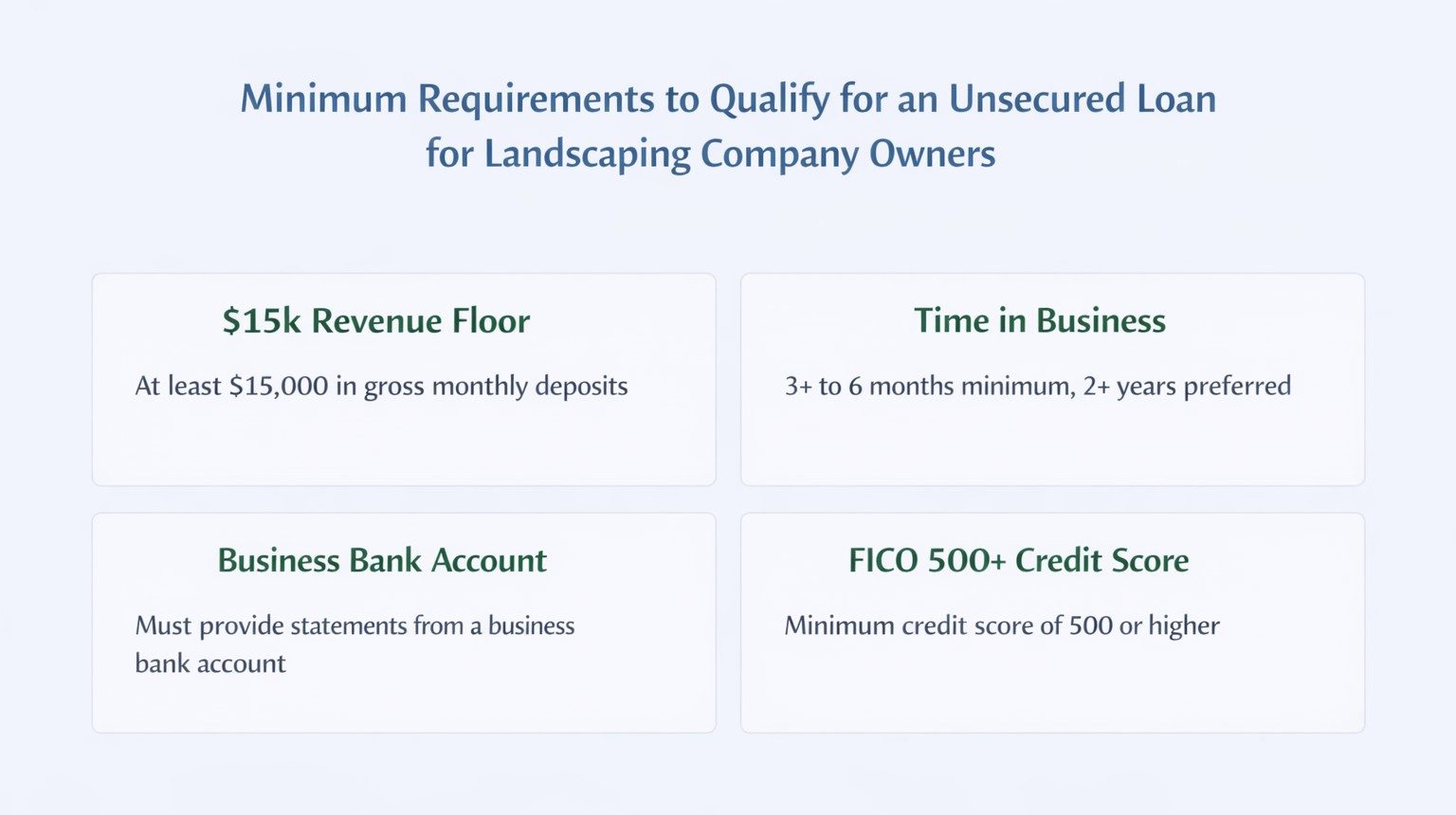
Minimum Requirements to Qualify for an Unsecured Loan for Landscaping Company Owners
Key Takeaways
- $15k Revenue Floor: Qualification begins with at least $15,000 in gross monthly deposits verified via business bank statements.
- Longevity Discounts: While only 3 to 6 months in business is required, 2+ years of operation typically unlocks lower factor rates.
- FICO 500+ Eligibility: High personal credit is not required; underwriters prioritize the consistency of your 2026 banking activity.
Revenue Minimums and Gross Deposits
Revenue is one of the main factors that guide unsecured loans. Lenders look for a minimum of $15,000 per month in gross deposits. It is important to remember that gross deposits and net profit are two different things; net profit is what is left after you deduct your expenses from your gross receipts. This distinction makes it easier to qualify for higher amounts as long as your total revenue justifies the payment.
Business Bank Account Requirements
You must also have a business bank account. We receive applications from borrowers all the time who submit personal bank statements, but underwriting guidelines only allow for statements from business accounts.
Time in Business and Operating History
A minimum of 3 to 6 months in business is also required to be considered for eligibility. Those with two years or more in business will typically qualify for better lending programs, as the longer you have been in business, the more stable your operation is perceived. Conversely, those with less than one year in business will usually pay higher factor rates due to a lack of operational history.
Personal Credit Flexibility
Personal credit is also reviewed, but it does not impact your ability to be approved as much as your revenue does. Underwriters generally look for a minimum credit score of 500. While those with better credit will get more favorable rates and terms, a low credit score will not keep you from an approval if your business revenue and banking activity demonstrate a strong ability to repay.
How Unsecured Loans for Landscaping Company Applications Are Approved
Key Takeaways
- The “Kill or Cement” Factor: Consistent, positive daily balances (ideally $1,000+) are the most critical signals for a fast approval.
- Customer Diversification: Underwriters look for at least 5 monthly deposits to ensure your business isn’t reliant on a single client.
- Position Stacking: Second-position loans are possible if revenue supports the debt, especially with a clean payment history.
Revenue and Banking Activity Review
When underwriters review applications, they look at a variety of factors. As stated, revenue is the primary factor that drives approval. However, your banking activity around that revenue is what either kills or cements the deal.
Average Daily Balance and Account Health
One important factor that is reviewed is your average daily balance, as well as your ending and beginning balance. A paper lender, for example, looks for an average daily balance of at least $1,000. Most lenders like to see that you are positive on a regular basis and not in the red.
NSF Activity and Cash-Flow Stability
Underwriters also look for minimal NSF activity. More than five NSF charges in any three or four-month period is usually looked at negatively. You can still get approved with more; however, your factor rate is going to be affected. Businesses without NSF charges show that the business is profitable and under good management.
Deposit Volume and Customer Diversification
Lenders also look for the number of deposits coming from your customers. A minimum of five monthly deposits is required by many underwriters. The more deposits your business has, the more diversified your customer base. A business with limited deposits more than likely has too few customers and is at risk of losing everything if something happens to that customer.
Existing Unsecured Loans, Stacking, and Payment History
Underwriters also look at your existing unsecured loan obligations if you have any. You may still be approved for another loan or what is called a position if your revenue is greater than your outstanding debt obligations. This is also called stacking. Many underwriters like to come in as the second position behind another loan. Good payment history with another lender is also looked at positively.
Time in Business and Operating History
Time in business also affects your approval. As mentioned, underwriters look for at least 3 to 6 months in business. Some underwriters require that your business be in operation for at least two years. A business that has been around on paper for 10 years but has no income or bank statements will not qualify. You must be in operation with ongoing verifiable revenue since inception.
Minimum Credit Score Considerations
Lastly, you must have at least a 500 FICO score to be considered for eligibility. Unsecured working capital is like any other loan in that better credit gets better rates and terms. Although, bad credit borrowers with steady cash flow that meet all the requirements will be approved as well.
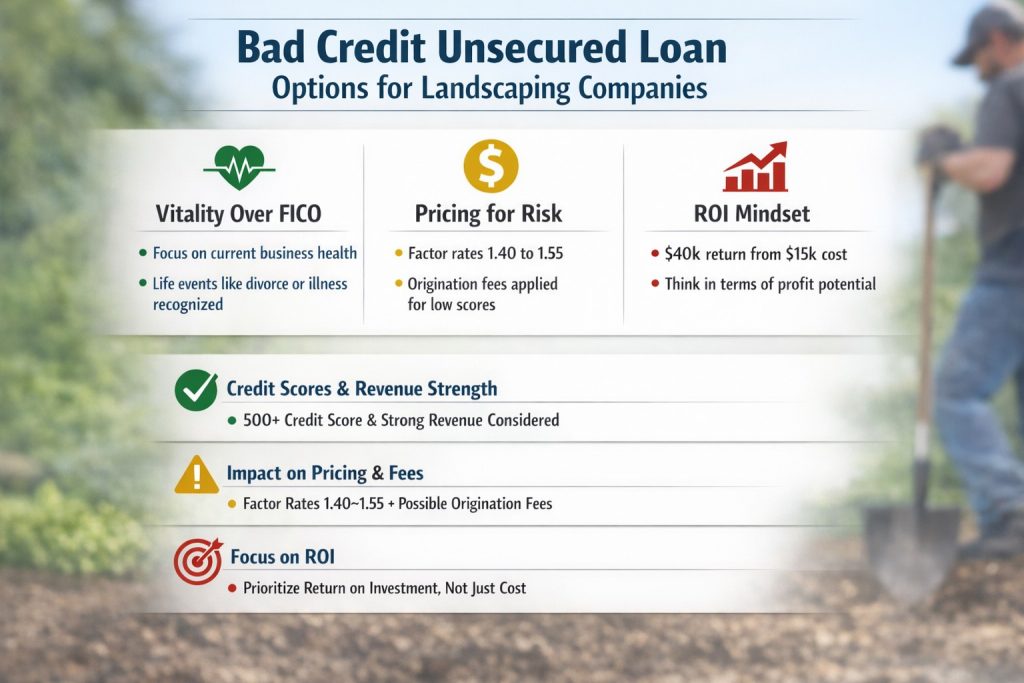
Bad Credit Unsecured Loan for Landscaping Company Options
Key Takeaways
- Vitality Over FICO: Underwriters acknowledge that “life happens” (divorce, sickness) and prioritize current business health over past credit issues.
- Pricing for Risk: Expect factor rates between 1.40 and 1.55 and potential origination fees for scores near the 500 floor.
- ROI Mindset: Focus on the $40k return from a $15k fee rather than just the cost of capital to unlock profitable opportunities.
Why Credit Issues Happen and How Underwriters View Them
There are many reasons people have bad credit. Issues such as divorce, a death in the family, or sickness can cause unforeseen and uncontrollable problems. Underwriters recognize these issues; rather than focusing solely on credit, they look at your business revenue and the overall vitality of your operation.
Minimum Credit Scores and Revenue Strength
Borrowers with credit scores of 500 or greater are still eligible for approval. Those with less than a 500 credit score should work on improving their credit prior to applying. We have funded contractors of all types with low credit scores. Those with strong, consistent revenue and good average daily balances who meet all the criteria for eligibility can still get funded.
How Bad Credit Impacts Pricing and Fees
Contractors who apply for an unsecured loan with bad credit must also understand that the total payback is going to be affected by your credit score. I get calls from merchants with low credit demanding the best rates; the truth is, underwriters are not going to take that kind of risk at a minimal cost.
Expect that your factor rate will be somewhere between 1.40 and 1.55. This price reflects the risk. In some cases, underwriters will charge additional origination fees on bad-credit borrowers. This means they will deduct a percentage to cover the fee from your loan amount. For example, if you borrow $20,000 with a 7% origination fee, expect to receive $18,600.
Focusing on ROI Instead of Just Cost
You should never focus only on the cost of the loan; you should always focus on your return on investment. If you have to pay $15,000 in financing fees to make back $40,000, then you have made a handsome return. All borrowers, whether they have good or bad credit, should always focus on a positive ROI.
The Speed and Process of Getting Funded
Key Takeaways
- DecisionLogic Verification: Real-time bank verification ensures revenue is current and discloses any unreported funding to finalize approval.
- Merchant Interview Guardrail: Funding is strictly for business use; mentioning personal use during the interview will trigger an automatic denial.
- Same-Day Wire Potential: Clear the 4:00 PM ET wire cutoff to receive your cash infusion the same day final underwriting is complete.
Submitting Your Application and Bank Statements
Speed to your bank account is one of the main advantages of applying for an unsecured loan for a landscaping company. You can be funded in 24 to 48 hours—sometimes faster if your business exceeds qualifications. Simply fill out a credit application and upload your last 3 to 4 months of business bank statements.
Receiving Your Pre-Approval and Reviewing Terms
Once all your documents are submitted, you will receive a pre-approval either the same day or the next. At this point, you will be presented with all terms and conditions of the loan. You will then be asked to submit your driver’s license and voided check should you decide to move forward.
Final Underwriting and Bank Verification
The next step is to go through the final underwriting process. At this point, the underwriter will do a more thorough analysis of your bank statements and a background check; they will also ask you to connect your bank account via a DecisionLogic link. This allows the lender to review your most current banking activity in real-time. Underwriters look to see that your revenue is in line with past performance and has not taken a significant drop. They will also be able to determine if you have taken any other funding that has not been disclosed. Undisclosed additional funding can result in your loan being denied or repriced.
Merchant Interview and Final Approval
Once you pass final underwriting, you will be asked to do a merchant interview. At this point, the underwriter will call and ask you some questions in regards to your business as well as the use of funds. Funding can only be used for business purposes and not anything personal. You will be denied funding if you mention that you will be using your loan for anything other than for your business.
How Funds Are Delivered to Your Bank Account
Your funding will be sent via wire transfer or ACH once the final merchant interview is complete. Wire transfers sent before the 4:00 PM ET cutoff will be received the same day. Anything sent after that is received the following day. ACH transfers usually take 24 to 48 hours.
Construction Company Working Capital by Funding Amount
Key Takeaways:
- The Right Amount for Any Job: You can get loans from $25,000 up to $500,000, making it easy to pick the exact amount you need whether you are just covering weekly payroll or starting a massive commercial project.
- Fast Approvals with Less Paperwork: For loans up to $150,000, you can get approved in 24 to 48 hours using just your bank statements—no tax returns required.
- No Collateral Needed for Big Projects: Even our largest tiers ($250,000 to $500,000) are unsecured, meaning you can handle slow-paying customers or huge upfront material costs without putting up your equipment or property as collateral.
Flexible Funding Options for Small to Large Construction Projects
Not every situation or contractor requires the same amount of working capital. In some cases, you may need a smaller amount to cover expenses such as payroll taxes or insurance. Other times, you may need a larger amount to finance a large purchase order for a municipal contract. Make wiser decisions when you know how the right funding amount fits your business and situation.
FlexLendCapital.com, provides working capital for your construction company structured into different funding ranges based on your qualifications and needs.
$25,000 to $250,000 Working Capital
A $25,000 to $250,000 construction company loan can provide your business with the flexibility it needs to respond to a variety of situations. You can use your funds for equipment rental, materials or just about any business related expense you may need. Learn how to apply for a $25,000 or more loan for your construction company.
$40,000 to $150,000 Payroll and Cash Flow Funding
Contractors can use a $40,000 to $150,000 no doc contractors working capital loan to cover urgent payroll needs while waiting on customer draws. Apply for a $40,000 contractors loan and be funded in 24 to 48 hours or less.
$100,000 No-Doc Working Capital
A $100,000 no-doc working capital contractors loan can help you get approved fast with a minimal amount of paperwork. Get approved based on your bank statements and not your tax returns.
$250,000 Unsecured Working Capital
Take on large government or commercial projects with a $250,000 loan for construction company owners. Use the funds to cover expenses such as materials, labor, equipment or just about anything you need to get the job moving.
$500,000 Large Project Working Capital
Apply for a $500,000 contractors business loan to finance large scale projects or multiple projects at the same time. Use your funds to handle large payroll obligations, retainage delays, and major upfront project expenses.
How Trade-Specific Working Capital Solves Cash Flow Delays
Key Takeaways:
-
Beat the Wait for Payments: Whether you are waiting for an insurance claim, a Certificate of Occupancy, or a general contractor to pay you, these loans bridge the gap so you can keep working.
-
Prep for Busy Seasons: Use fast capital to stock up on bulk materials like shingles or HVAC parts before seasonal rushes hit and prices go up.
-
Fast Cash for Daily Costs: Get funding in 24 to 48 hours to take care of urgent payroll, supplier invoices, and crew mobilization without draining your reserves.
General Contractors
General contractors use working capital loans for contractors to finance purchase orders related to commercial and municipal projects. Access to working capital can provide liquidity to cover expenses such as payroll, materials such as steel, or other business-related expenses. Fund your construction company when receivables exceed cash on hand.
HVAC Contractors
Business loans for HVAC contractors can be used to prepare for busy summer and winter seasons. Funds can be used to purchase inventory such as condensers, thermostats, or R-32 refrigerants. Hire technicians or make emergency repairs to your service vehicles. Funding in 24 to 48 hours can help your business respond quickly to seasonal demand changes.
Roofing Contractors
A business loan for roofing contractors can help your business purchase shingles and materials in bulk. Be ready to respond during storm season or hedge against rising price increases. Working capital for your roofing business can help cover overhead while waiting for insurance companies to release final claim payments.
Electrical Contractors
Electrical contractors sometimes need to wait months for final payment until a project receives its Certificate of Occupancy. Regardless, expenses and payments do not stop. A loan for electrical contractors can help bridge the gap between expenses and final payments and keep your business moving forward.
Plumbing Contractors
Plumbing contractors must also manage expenses when waiting on retainage payments or jobs to reach completion. Access to working capital for plumbers can help cover those expenses and make managing your business easier and less stressful.
Trade Contractors
Trade contractors such as drywall or concrete subs are often at the mercy of the general contractor to get paid. This can take 30, 60, 90 days or longer. Fast funding for trade contractors in 24 to 48 hours can help your subcontractor business manage cash flow and take on additional projects without straining cash flow.
Helpful Contractor Lending Guides
To pinpoint the exact cash flow tool your business needs right now, look through our specific financing resources:
-
Construction Company Loan: A clear look at working capital limits, underwriting rules, and unsecured funding structures tailored for builders.
-
Bank Statement Contractor Working Capital Loans: See how to bypass traditional tax documents and unlock fast cash using your everyday business checking activity.
-
Construction Business Loans for Contractors: Understand how independent trade crews deploy quick capital to handle high job-start expenses and cover payroll delays.
How to Decide If an Unsecured Loan for a Landscaping Company Makes Sense
Key Takeaways
- Opportunity Cost: Compare profit potential to loan cost—if taking on new pavers or gravel jobs exceeds the premium, the loan is worth it.
- Avoid Debt Spirals: Never use short-term capital to pay off credit cards or failing operations; stabilize expenses first.
- Worker Loyalty: Use quick funding to ensure crews are paid on time every time, maintaining the labor force required to finish jobs.
Evaluating Return on Investment
You should always evaluate your return on investment before taking out short-term working capital for your business. This type of capital is best used if you are able to take on additional opportunities that you would otherwise not be able to do. Always compare your profit to the cost of the loan. If your profit exceeds costs, then it is definitely worth a small premium.
When Timing is Critical
Unsecured capital is also helpful when timing is critical. Crews need to have certain materials, such as pavers or gravel, to complete jobs. Working capital is essential in order to make sure these things make it to your job site on time. It’s also important to have your crews paid on time at all times; workers who aren’t paid on a regular schedule will not stay loyal. Quick access to funding ensures materials arrive on time while keeping workers paid and jobs moving forward on schedule.
What to Avoid: Debt Cycles
Short-term capital should never be used to pay off credit card debt or other unsecured loans. It is not wise to pay interest on top of interest. This will create a compounding interest effect that will quickly become unmanageable. I never advise contractors or other merchants who are looking for a loan to pay off another to do so.
Don’t Use Debt to Save a Failing Operation
You should never use this type of capital to keep your business from closing its doors. Look for other ways, such as downsizing, to keep your business going. Additional short-term debt to fund a failing operation usually makes the situation worse. It is better to stabilize expenses and restructure operations before taking on more debt.
Frequently Asked Questions (FAQ)
How fast can I get funding for my landscaping company?
You can have funds within 24 to 48 hours once your bank statements and credit application have been submitted. Same-day funding is available for well-qualified borrowers. Ask for more information.
How much revenue do I need to qualify?
You need $15,000 or more per month in gross deposits. Stronger revenue can unlock higher approval amounts.
Can I qualify with bad credit?
Yes. Underwriters focus on revenue and banking activity rather than credit alone. Scores as low as 500 are eligible for consideration. Pricing and terms typically reflect your credit score.
What are the payment terms, and how often do I need to make a payment?
Terms range from 3 to 24 months. Payment frequency is handled via ACH payment processing, either weekly or daily, depending upon case-by-case approval.
Can I get an early payoff discount?
Yes, early pay discounts are usually on a sliding scale basis. Greater discounts are given toward the start of the loan and reduced each month. You should request your early pay discount in your contract.
Can I have more than one unsecured loan at a time?
Yes, as long as your revenue supports the additional position. This is also known as “stacking.” However, some “A” paper lenders will advise against stacking.
What can I use the funds for?
Funds must be used strictly for business purposes, such as payroll, equipment rentals or repairs, materials, fuel, insurance, or marketing expenses.
Do I need collateral to get approved?
No. These loans are unsecured, meaning assets such as equipment or real estate are not pledged as collateral. However, you are typically required to provide a personal guarantee.
What is a factor rate?
A factor rate is how your total payback is calculated. It is based on a fixed decimal multiplied by the amount that you wish to borrow. For example, a $50,000 loan × 1.37 factor rate is $68,500. This amount is fixed and does not accrue over time like traditional interest.
When should I avoid taking an unsecured loan?
Never use it to pay off other debt, such as credit cards or other unsecured loans. Do not use it to keep your business from failing either. These loans work best for bridging gaps between payment cycles and taking on additional opportunities.