
Key Takeaways
- Speed to Capital: Access funding in as little as 24 to 48 hours, significantly faster than the 30 to 90-day timelines required by traditional bank or SBA products.
- No Asset Pledges: Secure anywhere from $15,000 to $2,000,000 without the need to pledge real estate, equipment, or other personal collateral.
- Cash Flow Based: Underwriting focuses on your actual banking activity and revenue velocity rather than relying strictly on tax returns or high FICO scores.
- Operational Flexibility: Use funds for any immediate business-related purpose, including payroll, 941 taxes, and inventory for upcoming project mobilizations.
Construction Business Loans for Contractors Without Collateral
Construction business loans for contractors without collateral are a good alternative when you need working capital in 24 to 48 hours or less. Traditional bank loans and SBA loans require extensive documentation, good credit, and in some cases collateral. Working capital for contractors can be used to cover expenses such as payroll, 941 payroll taxes, worker’s compensation, equipment rental, or any business-related expenses when receivables exceed cash in the bank. A construction business loan is also a great way to finance your next big project without having to pledge collateral or wait weeks or months for funding.
Revenue-Based Underwriting for Construction Business Loans
Unsecured business loans for contractors focus on your revenue over your tax returns and credit. Alternative lenders are not subject to the same strict underwriting guidelines set by the Federal Reserve. This type of flexibility allows unsecured lenders to extend credit when banks won’t or require collateral. Underwriters focus on your revenue as well as your overall banking activity, such as your average daily balances as well as the frequency of your deposits. Underwriting also evaluates your NSF activity and your beginning and ending balances. Strong banking activity demonstrates your ability to pay the loan regardless of credit.
What You Will Learn About Construction Business Loans for Contractors
As a current and former tension shade structure installer, I understand the importance of working capital for your construction company. Access to fast working capital in 24 to 48 hours can unlock opportunities you might otherwise miss. In this guide, I will explain how to apply for a construction business loan for contractors with no collateral. In it, you will learn about the requirements, how factor rates work, loan amounts, repayment terms, and frequency and how you can get funded as quickly as possible for anywhere from $15,000 to $2,000,000.
Construction Business Loans for Contractors Requirements and Qualifications
Key Takeaways
- Revenue Over Credit: Your gross monthly deposits are the primary driver for approval, allowing for funding even if personal credit is less than perfect.
- The $15k Threshold: Minimum qualification starts at $15,000 in monthly gross revenue, with higher volumes unlocking larger capital pools.
- Banking Health: Consistent daily balances and minimal NSF activity (fewer than 5 per quarter) are essential for securing the lowest factor rates.
- Stacking Flexibility: You can hold multiple loan “positions” simultaneously, provided your cash flow can comfortably support the additional daily or weekly payments.
Revenue Requirements and Approval Amount
The most important factor that is considered when applying for a construction business loan for contractors is your gross overall revenue. Gross revenue is not the same as net profit. Your net profit is the result of your gross revenue less your expenses. Underwriters focus on consistent revenue throughout each month.
You will need at least $15,000 a month to qualify for a loan. The higher your revenue, the more you will be able to unlock in approval amounts. Your approval is based on the average of your last 3 to 4 months of gross deposits, less any other unsecured loans for contractors that you might have. New York and California borrowers must submit the last 4 months due to state guidelines. Every unsecured loan you have is called a position. A first-position loan is calculated for borrowers anywhere but New York and California as follows:
- Month 1: $62,000
- Month 2: $86,000
- Month 3: $79,000
- Average: $75,666
You would qualify for around $75,000 of working capital so long as your business meets other requirements. Underwriters also want to make sure that your revenue is consistent and not trending downwards.
Deposit Frequency
You will also need to make 5 or more monthly deposits each month to show your stability. A business that has frequent deposits shows that it is stable and has a well-diversified customer base. Less than 5 monthly deposits raises the risk assessment of your file. You may be denied if your deposits are infrequent or face paying higher factor rates.
Banking Activity Requirements
Underwriting also reviews your overall banking activity when you apply for a contractor business loan. You will have to maintain positive daily and beginning and ending balances that show your ability to repay the loan. You will also need to keep your NSF activity to a minimum. More than 5 NSF charges in any given 3 to 4 month period can also cause paying higher factor rates. Excessive NSF charges will more than likely result in your business being denied financing.
Time in Business
You will need to have at least 3 to 6 months in business to qualify for construction business loans for contractors. Expect to pay a higher factor rate if your business has only been around for a short time. Contractors with 2 or more years in business typically qualify for better rates and terms and approval amounts. A longer operating history demonstrates that your business is stable and reduces your risk profile.
Credit Requirements
You will need a minimum FICO score of 500 to qualify for an unsecured working capital loan for contractors. Alternative lenders focus on your revenue and your overall banking activity vs. your credit score. You will still be eligible to qualify for approval so long as your cash flow shows it is capable of making the payment. Those with a strong credit profile may be able to qualify for better rates and longer terms.
Existing Loans or Positions
You can still qualify for another unsecured loan for your construction business if your income can handle the additional loan. We have funded contractors with multiple positions on many occasions. You can have as many positions as your business is capable of supporting. However, keep in mind that you will more than likely be required to make a daily payment when you apply for a multiple-position loan for contractors.
Factor Rates, Payment Terms, and Repayment Frequency for Construction Business Loans for Contractors
Key Takeaways
- Fixed Cost Predictability: Unlike variable interest, factor rates use a simple multiplier (e.g., 1.35) so you know the exact total cost of the capital before you sign.
- Case-by-Case Term Ranges: Approval terms are customized to your specific business profile, typically ranging from 3 to 24 months based on the strength of your application.
- Daily and Weekly Payment Frequency: Repayment is structured through automated ACH withdrawals that occur either daily or weekly, based on your risk profile as set forth by underwriting.
- Liquidity-Based Approval Incentives: Maintaining higher daily balances and consistent deposits directly improves your profile, helping you secure longer terms and more favorable weekly payment frequencies.
Speaking Factor Rates for Construction Business Loans for Contractors
Unsecured loans for contractors calculate your overall finance charges based on factor rates as opposed to accruing interest. A factor rate is a fixed-rate multiplier that is used in the formula. Factor rates can range from 1.22 to 1.55, or possibly more, depending on the overall financial standing of your business and your credit. To determine your overall finance charges, you need to multiply the factor rate by the loan amount. You will pay $35,000 in finance charges if your loan is $100,000 at a 1.35 factor rate, or $100,000 X 1.35 = $135,000 total payback. You will unlock the best factor rates with good credit and a strong business profile. Expect to pay more with less-than-perfect credit, with bad credit construction business loans for contractors paying the most.
Payment Terms for Construction Business Loans for Contractors
Your payment term is individually approved. Terms range from 3 to 24 months. The average approval range is 9 to 15 months, depending on your file. Longer terms have smaller payments; however, the loan becomes more expensive. Shorter terms have the least expensive terms but with a larger payment. Expect to pay a higher factor rate for a 15-month loan vs. a 3-month loan. No-collateral business loans for contractors are structured based on your cash flow and banking activity, which dictates your ability to pay the loan.
Payment Frequency for Construction Business Loans for Contractors
Your payment frequency is also determined on a case-by-case basis. Payments are either going to be weekly or daily. Daily payments are made Monday through Friday only, except for federal banking holidays. All payments are made via ACH withdrawal directly from your bank account at the agreed-upon time. Your payments will begin immediately once your business bank account has been funded. We work to get you the best payment arrangements that meet your business criteria. You will get better terms by maintaining strong positive daily and beginning and ending balances. You should also keep your NSF activity to a minimum and make frequent regular deposits to show consistent cash flow.

Common Reasons Construction Business Loans for Contractors Are Denied
Key Takeaways
- Universal Default Tracking: Underwriters use DataMerch to link your lending history to your Social Security number, ensuring past defaults on other businesses or with partners are visible.
- Modification Red Flags: Any deviation from an original payment agreement is flagged as a modification, signaling cash flow instability to potential lenders.
- Social Security Linkage: Federal EINs do not hide past performance. Personal accountability remains a primary factor in underwriting unsecured contractor loans.
- Strategic Repayment Importance: Maintaining the original terms of your agreement is essential for securing future funding and maintaining a clean profile on industry databases.
Defaults Detected Through DataMerch
Defaults are the most common reason I have seen for borrowers of all types to get denied funding. Underwriters use an online resource from DataMerch that tracks your lending history with unsecured lenders. Your history is tied to your Social Security number and not just your Federal EIN number. Defaults through other businesses that you might have owned on your own or even with a partner will show up. Unfortunately, past defaults with other businesses hurt your ability to be able to borrow in the future.
Payment Modifications Identified Through DataMerch
Payment modifications are another reason that no-collateral construction business loans for contractors are denied. A payment modification is any deviation that is made from the original agreement. It is considered a payment modification if you are behind on payments and need to make payment arrangements. Lenders look at this as a red flag due to cash flow issues with your business. Any deviations from your original agreement suggests to underwriters that your business is struggling and may not be able to make future repayments.
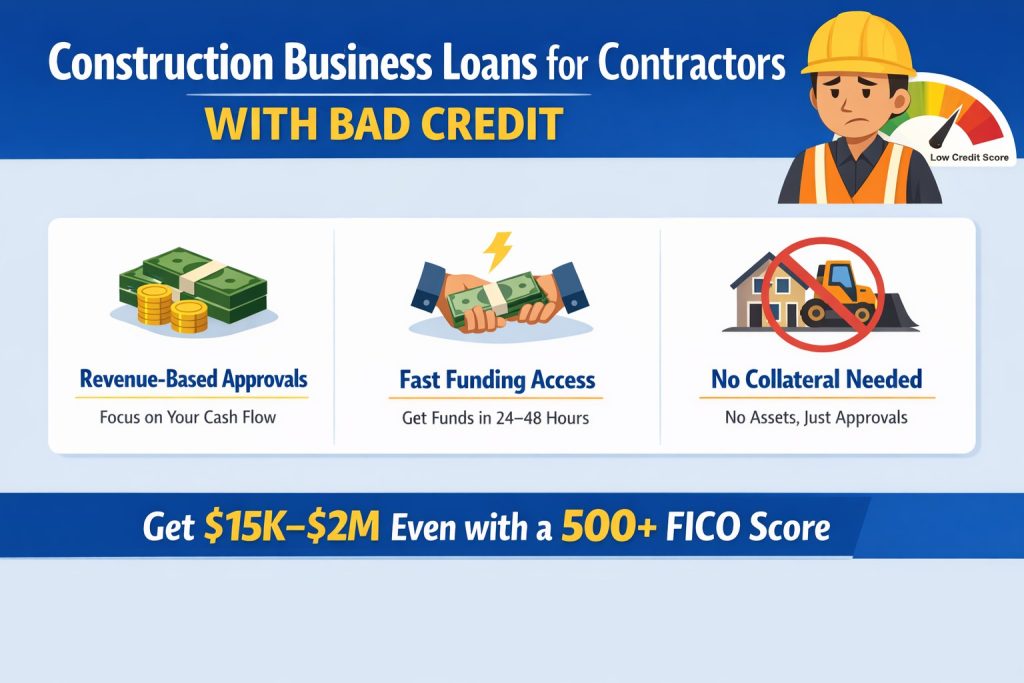
Construction Business Loans for Contractors With Bad Credit
Key Takeaways
- 500 Minimum FICO: You must have a credit score of at least 500 to qualify; anything below this is an automatic denial.
- Revenue-First Underwriting: Lenders prioritize your monthly deposit volume and daily account balances over your past credit history.
- Higher Factor Rates: Expect to pay more for capital. Bad-credit factor rates start at 1.40 due to the increased lender risk.
- 2-Year Bankruptcy Rule: You are eligible for funding as long as any past bankruptcies have been discharged or closed for at least 24 months.
Can Contractors Qualify With Bad Credit
You can get an unsecured construction business loan for contractors with a FICO score as low as 500. Underwriters focus more on your revenue and your overall banking activity vs. your credit. Your bank statements need to show consistent deposits, positive balances, and a minimum amount of NSF charges each month. Borrowers with closed bankruptcies that are 2 years or older may also apply for a bad credit loan for contractors. Borrowers with less than a 500 FICO score will not be approved.
How Bad Credit Affects Loan Terms
Bad credit does not affect your ability to borrow. However, you will be subject to a higher factor rate. Factor rates for bad credit borrowers will start around 1.40 and go higher from there. This additional cost is due to the increased risk profile associated with your account. Most lenders who finance bad credit borrowers, like auto lenders, also charge higher fees. This is how the finance industry of any sort works. However, with work on your credit and a good payment history, you will be able to qualify for better rates in the future.
How to Apply for Construction Business Loans for Contractors Without Collateral
Key Takeaways
- Business-Only Account: Personal bank statements or third-party processors like Stripe/PayPal are not accepted. Funds must be in a dedicated business account.
- SSN and EIN Requirement: Your Social Security number is required alongside your Business EIN to track your global lending history via DataMerch.
- Real-Time Verification: Lenders use DecisionLogic for a one-time, real-time look at your current month’s revenue to confirm your cash flow hasn’t dropped since your last statement.
- 4:00 PM ET Wire Cutoff: To receive your funding on the same day as your merchant interview, all final approvals must clear the 4:00 PM ET wire window.
Submit Credit Application
To apply for a business loan for contractors, you need to submit a credit application online. This short application requires that you complete information such as your business name, personal name, business and personal address, and how long you have been in business. You will also need to submit your Social Security information and your Federal EIN number.
Submit Business Bank Statements
Once you complete the credit application, you will need to submit the last 3 to 4 months of your business bank statements. New York and California residents will need to submit the last 4 months to follow state regulations. You may not submit any personal bank statements or statements that belong to an online processor such as Stripe or PayPal. You will need to transfer those funds into your business bank account. Your last 3 to 4 months of bank statements must also come from the same account. You can submit multiple bank accounts so long as the accounts are all consistent from the same bank and the same account.
Receive Pre-Approval Offer
Once you have submitted your credit application and the correct bank statements, your file will be presented to underwriting for a pre-approval offer. If qualified, your pre-approval offer will include details such as your loan amount, terms, and payment frequency. You will receive a pre-approval offer usually within the same day sometimes within a few hours.
Sign Loan Documents
Your loan documents will be sent to you via DocuSign for you to review and sign electronically once you agree to the pre-approval offer. You will then have to sign the document and send back your state-issued driver’s license and a voided check. In some cases, you will also be required to submit proof of business ownership. You can submit the articles of incorporation from the Secretary of State, or tax documents such as your 1040 for sole proprietors or your K-1 for partnerships or S-corps.
Final Underwriting Review
The next phase of the funding process is to pass final underwriting. During this phase, underwriters will do a more thorough review of your business bank statements and a DataMerch search to look for any past defaults or payment modifications with any other unsecured lenders with your current or past business. Underwriters will also connect to your business bank account via DecisionLogic to do a one-time, real-time bank verification of your current month. During this review, underwriters will look at your current month’s revenue and to see if you have taken out any other undisclosed unsecured loans. Other loans that have not been disclosed can affect your loan amount and pricing. You can also be denied if your business is unable to support an additional payment due to the recent loan.
Merchant Interview
You are much closer once you pass the final underwriting review. The next step before final funding is to complete a short merchant interview. The underwriter will ask you a few basic questions about your business and the use of the funds. You may only use the proceeds for any business-related purposes. You may not use the funds for anything that is related to personal business, and stating so may cause being denied.
Final Funding
Final funding is sent once you have successfully completed the merchant interview. Your funding will be sent to you via same-day wire transfer. Wire transfers sent before the 4:00 PM ET wire cutoff will arrive the same day. Anything sent after that will be available the next day at the latest. ACH transfers can take 24 to 48 hours.
Construction Trades That Use Unsecured Construction Business Loans for Contractors
Key Takeaways
- Float Large Contracts: General and electrical contractors can bridge the gap between upfront mobilization costs and Net 30/60/90 commercial payouts.
- Seasonal Inventory Prep: HVAC and roofing crews can stock up on high-demand units or R32 refrigerants before peak summer or storm seasons hit.
- Purchase Order Financing: Subcontractors in plumbing and landscaping can use unsecured capital to fulfill large POs without draining their operating accounts.
- Asset Protection: Access up to $2,000,000 in working capital to compete for government or municipal bids without having to mortgage your home or pledge equipment.
General Contractors
General contractors use unsecured construction working capital loans for a variety of reasons, the primary being to cover expenses when receivables exceed cash on hand. General contractors are sometimes required to cover expenses such as payroll and materials upfront and are paid only when the job is completed. Also, some projects pay on Net 30, 60, or 90-day terms that can drain cash flow. Access to unsecured working capital for contractors allows your business to cover these costs while you wait. General contractors who bid on commercial or municipal projects must be able to accept purchase orders. You can also use your construction business loan to finance purchase orders and scale your business to new levels.
HVAC Contractors
HVAC contractors can also use short-term working capital to cover inventory purchases to keep up with seasonal demands. Short-term loans for HVAC can help you purchase condensers and AC units, or even stock up on R32 refrigerant for the dog days of summer. Access to short-term business loans without collateral can help you manage weather fluctuations and keep your technicians busy and your customers happy.
Roofing Contractors
Roofing contractors can use short-term unsecured construction business loans for purchasing materials, such as Owens Corning shingles, to be ready for storm season. Roofing contractors often work with insurance claims, which can take weeks to pay out. These delays can strain your cash flow and make it harder to take on multiple jobs at once. Unsecured loans for roofing contractors provide the capital you need to scale your business and maintain availability during peak demand.
Electrical Contractors
Electrical contractors that want to compete for large-scale government or commercial projects must be willing to work with purchase orders. In the meantime, electrical contractors must float all upfront costs such as labor, materials, permits, and equipment rentals. Short-term working capital loans for contractors help cover those cash flow gaps so you can compete on a large scale without having to mortgage your home or personal assets.
Plumbing Contractors
Plumbing contractors who want to secure big contracts often work as subcontractors on large commercial projects. General contractors issue purchase orders, meaning a sub like a plumbing contractor must cover all expenses upfront until the job is completed. Delays caused by weather or lack of materials for non-plumbing related issues can also stall your payments. No-collateral working capital loans for plumbing contractors provide the cash cushion needed to keep crews working, even when project milestones are delayed.
Landscaping Contractors
Landscaping contractors are also frequently hired as subcontractors. General contractors often issue purchase orders for landscaping firms to complete large projects, such as installing a multi-acre irrigation system. Projects like these are capital-intensive, requiring upfront payment on everything from excavator rentals to PVC pipe. Access to working capital loans for landscaping contractors ensures your business is ready to mobilize the moment such projects arise.
How Contractors Use Construction Business Loans to Grow and Manage Cash Flow
Key Takeaways
- Payroll Stability: Bridge the gap between Net 30, 60, or 90-day invoice cycles and the immediate need to keep crews paid and projects moving.
- Mobilization Capital: Secure the upfront funds required for steel, lumber, and concrete to fulfill large commercial or government purchase orders.
- Seasonal Readiness: Lock in inventory like R32 refrigerant or roofing shingles before peak demand hits to ensure your team can respond to every lead.
- Emergency Response: Access a 24 to 48-hour cash infusion to repair critical heavy equipment, like cranes or bulldozers, and avoid costly downtime.
Construction Business Loans for Contractors to Cover Payroll
As a contractor, you often have to wait for invoices that pay Net 30, 60, or 90 days. In the meantime, crews need to be kept working and jobs moving forward to avoid delays. A construction business loan for contractors to cover payroll can help stabilize your business when you are waiting on receivables. A fast 24 to 48-hour cash infusion can help your business prevent costly delays and keep your workers fed.
Construction Business Loans for Contractors to Purchase Materials
Large commercial and government projects often require that you be willing to work with purchase orders that pay upon completion. To bid, you need to be able to purchase materials such as steel, drywall, concrete, lumber, or any other special materials you need to complete the job. An unsecured construction business loan for materials can help your business make these purchases by providing you the necessary capital to mobilize.
Construction Business Loans for Contractors to Buy Inventory
Subcontractors, such as roofing companies and HVAC contractors, need to purchase materials to be ready for seasonal demands. A roofing contractor can use a no-collateral business loan for inventory to purchase shingles or underlayment for storm season. HVAC contractors can be ready to respond to the latest heat wave with plenty of R32 refrigerant on hand.
Construction Business Loans for Contractors to Handle Emergency Expenses
Contractors are often faced with emergency situations, like heavy equipment breakdowns. Repairing heavy equipment, such as a large crane or even a bulldozer, can cost thousands—if not tens of thousands—of dollars. Every day that equipment is not working can cause lost revenue. A construction business emergency loan for contractors can help your business be ready for an emergency.
Construction Business Loans for Contractors for Advertising and Marketing
An advertising business loan for contractors can help your business scale to new levels. Marketing channels such as Google Ads and Facebook require capital upfront to test, deploy, and successfully increase your lead flow. More expensive venues, such as billboards, can give your roofing company exposure it never had. Apply for an advertising business loan for contractors to grow your business.
Looking for Another Option?
If your business requires a different capital structure or a specific funding range, check out our full suite of programs:
-
$25,000 to $250,000: Unsecured Contractor Loans for general business growth and everyday overhead.
-
$40,000 to $150,000: Payroll & Cash Flow Funding to cover urgent labor expenses while waiting on customer draws.
-
$100,000: No-Doc Working Capital for streamlined approvals based strictly on bank statements.
-
$250,000: Unsecured Construction Loans to scale up for government or major commercial contracts.
-
$500,000: Large Project Working Capital engineered for enterprise contractors managing heavy retainage gaps.
Frequently Asked Questions (FAQ)
Key Takeaways
- $15k to $2M Limits: Borrowing capacity is determined by your average monthly deposits over the last 90–120 days.
- No-Doc Threshold: Tax returns are typically waived for all contractor loans under $150,000.
- 500 FICO Floor: Credit is secondary to revenue, but a minimum score of 500 is required for eligibility.
- Rapid Wire Transfers: Funding is delivered via same-day wire once the 4–8 hour underwriting process and merchant interview are complete.
What are construction business loans for contractors?
Construction business loans for contractors are short-term working capital solutions that help your business cover expenses such as payroll, materials, workers’ compensation, permits, and advertising. These no-collateral loans are designed with speed and flexibility so you can have funds in your account in 24 to 48 hours or less.
Can I get a contractor loan without collateral?
Yes. You can get a short-term working capital loan without pledging personal assets or equipment. You will be required to provide a personal guarantee, similar to a standard business credit card. Approval is based on the health of your banking activity, specifically your daily balances and NSF history.
How much can I borrow with a contractor loan?
You can borrow between $15,000 and $2,000,000. Approval is based on the average of your last 3 to 4 months of deposits (4 months for NY or CA borrowers). You need a minimum of $15,000 per month in gross revenue to qualify.
How fast can I get funded?
Funding typically occurs within 24 to 48 hours. Pre-approvals are usually sent the same day, and the entire underwriting process takes about 4 to 8 hours. Wire transfers are initiated the same day the merchant interview is completed.
Do I need tax returns for a construction working capital loan?
Tax returns are not required for loans under $150,000. For amounts above $150,000, underwriters typically request the last 1 to 2 years of returns. To satisfy these stipulations, you can submit IRS Form 1120, Schedule C, or Form 1065 along with your K-1 schedule.
Can I qualify with bad credit?
Yes. You are eligible to apply with a FICO score as low as 500. Lenders prioritize your revenue and banking activity (average daily balances and NSF charges) over your credit score. FICO scores below 500 will not be approved.
What are factor rates on contractor loans?
A factor rate is a fixed multiplier used to calculate the total cost of an unsecured loan. To find your total payback, multiply the factor rate by the loan amount. For example: $100,000 (Loan) $\times$ 1.33 (Factor Rate) = $133,000 Total Payback.
What can contractor loans be used for?
They can be used for any business-related purpose, including payroll, inventory, equipment repairs, and marketing. They are especially effective for bridging cash-flow gaps caused by Net-30 or Net-60 payment delays.