Key Takeaways
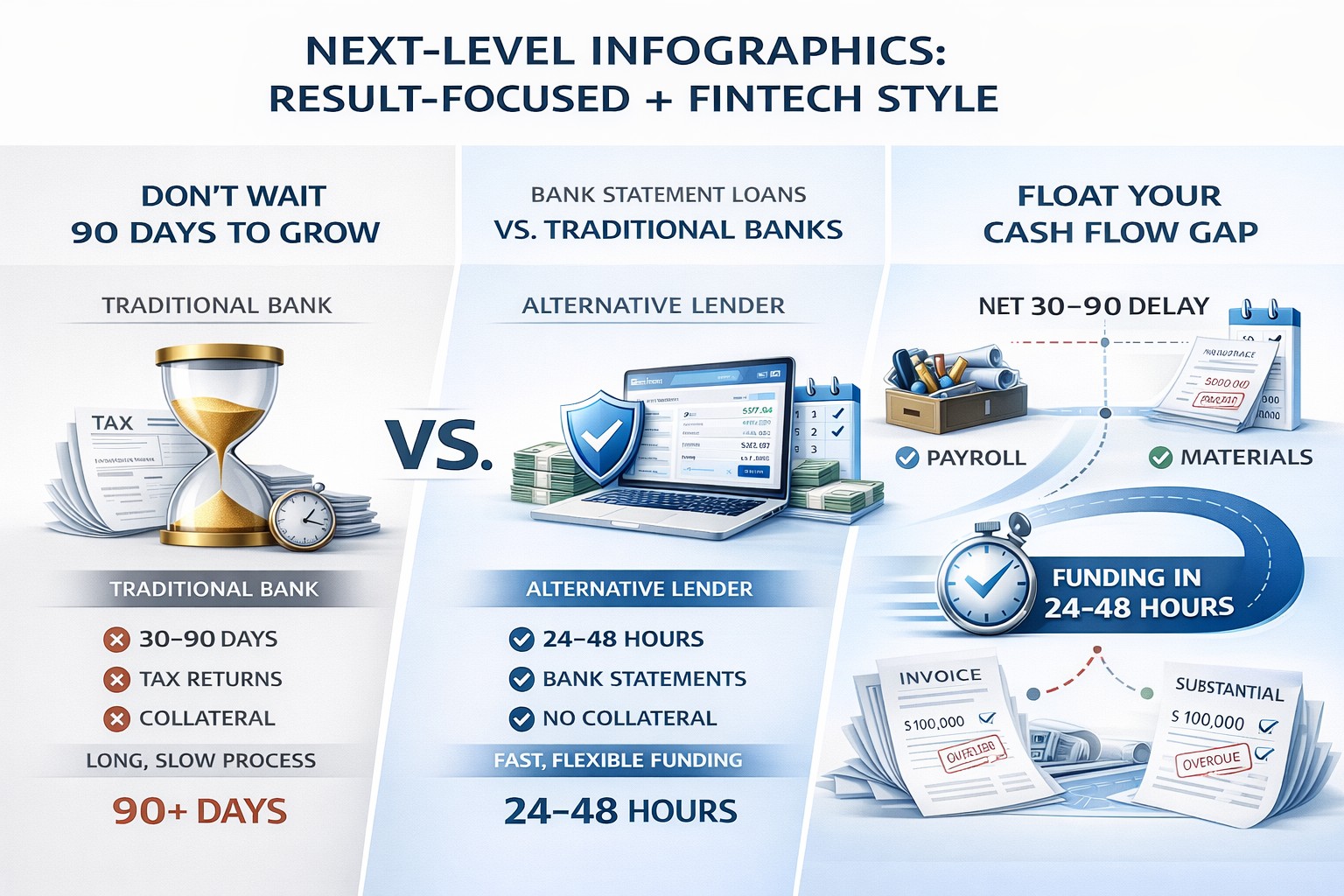
- No Tax Returns Required: Qualify for up to $2,000,000 in working capital using only your most recent 3 to 4 months of business bank statements.
- Rapid Funding Speed: Receive approvals and funding in as little as 24 to 48 hours, providing a significant advantage over traditional 90-day bank cycles.
- Collateral-Free Financing: Access significant liquidity without the need for real estate liens, equipment pledges, or lengthy asset appraisals.
- Industry Flexibility: Designed specifically for contractors to bridge the gap between project mobilization and Net-30 to 90 payment cycles.
Why Contractors Choose Bank Statement Loans Over Traditional Bank Financing
Construction company owners sometimes prefer bank statement contractor working capital loans instead of traditional bank or SBA loans due to the speed and flexibility offered. Traditional bank and SBA loans require extensive documentation such as two years of personal and business tax returns, twelve months of business and personal bank statements, and other financial documents such as profit and loss reports and balance sheets. Alternative lenders do not have to follow the same underwriting guidelines and therefore can offer greater flexibility and faster approvals.
How Bank Statement Underwriting Works
Unsecured alternative lenders focus on your last three to four months of business bank statements rather than your tax returns or collateral. This gives alternative lenders speed when it comes to getting your business funded. There is no need to pledge collateral or wait for lengthy appraisals to apply for a bank statement unsecured contractors loan. You can access anywhere from $25,000 to $2,000,000 in just 24 to 48 hours once all the proper documents have been submitted and processed. This type of flexibility allows contractors to cover urgent expenses when customers pay late or to finance purchase orders.
What You Will Learn in This Guide
As a current business owner and former tension shade structure contractor, I understand the importance of working capital for any construction business. In this guide, I will explain how you can get a bank statement contractors working capital loan in 24 to 48 hours or less. You will learn about factor rates, loan terms, payment frequency, and how to pass final underwriting so your business can secure funding quickly.
What Are Bank Statement Contractor Loans?
Key Takeaways
- Revenue-Focused: Underwriting prioritizes your actual cash flow and deposit history over the last 3 to 4 months instead of tax returns.
- Speed of Execution: Pre-approvals are typically issued in hours, with full funding available in 24 to 48 hours or less.
- No Asset Pledges: This is a truly unsecured product, meaning no appraisals or liens on equipment or real estate are required.
- Cash Flow Bridge: Designed to cover immediate costs like payroll and materials while waiting on slow-paying commercial or municipal receivables.
How Bank Statement Loans Work
Bank statement working capital loans for contractors do not work the same as traditional loans like banks or the SBA. Alternative lenders focus on your revenue over your tax returns and/or profit and loss statements. Alternative lenders analyze the last 3 to 4 months of your bank statements. This type of assessment allows them to determine the health of your business through a thorough bank statement analysis. In it, underwriters will look at factors such as your revenue, balances, overdraft charges, and the frequency as well as consistency of your deposits.
This short analysis based on your bank statements allows the underwriter to make a faster decision regarding your pre-approval than standard type loans. Lenders can make a decision in hours instead of waiting for weeks or months. There is also no need to pledge any collateral, eliminating the need for appraisals which can delay funding even more. Short-term bank statement contractor loans can be funded in 24 to 48 hours, or in some cases less.
Why Contractors Use Bank Statement Financing
Construction companies use bank statement financing for contractors for a variety of different reasons. One of the primary reasons is to cover gaps in cash flow when customers are late on payments. Contractors often have to cover expenses upfront while customers pay Net 30, 60, or 90 days. In the meantime, expenses such as payroll, 941 payroll taxes, insurance, and rent don’t stop. An unsecured bank statement loan can help you cover these expenses when your cash is tight and receivables are pending.
Short-term bank statement loans are also good for financing purchase orders to complete commercial and municipal projects. These types of jobs can be very lucrative but include purchase orders that are paid upon completion. This requires working capital to complete. Having access to working capital when banks say no can help unlock profits you may have otherwise lost. Unsecured contractors working capital allows you to accept purchase orders, keep crews moving, and make money for your business.
Revenue Requirements for Bank Statement Contractor Working Capital Loans
Key Takeaways
- Entry-Level Threshold: A minimum of $15,000 in gross monthly revenue is required to qualify for a bank statement contractor loan.
- Revenue-Based Scaling: The total amount of working capital available is directly proportional to your average monthly deposit volume.
- 3 to 4 Month Snapshot: Underwriters use your most recent bank statements to verify cash flow, with a 4-month requirement for New York and California residents.
- Streamlined Underwriting: Unlike the SBA or traditional banks, the process is optimized for speed by focusing on banking activity rather than tax returns.
Minimum Revenue Needed to Qualify
You will need a minimum of $15,000 per month of gross monthly revenue to qualify for a bank statement contractor loan. Your deposits are verified via your last 3 to 4 months of business bank statements. The greater your monthly revenue, the more working capital you will be able to obtain. Consistent and frequent deposits will also increase your chances of qualifying for a loan. Underwriters also look at other factors such as your banking activity to determine if you are eligible. Unlike banks or the SBA, unsecured lenders offer a fast, streamlined process that makes getting funded fast and easy.
How Revenue Determines Loan Size
The amount of funding you are able to borrow is based around the average of your last 3 to 4 months of deposits, less any other unsecured loans that you may have. Underwriters will look at the last 4 months of deposits for borrowers in New York and California due to state regulations. Underwriters will also factor in your time in business as well as the overall financial health to determine the maximum amount you will be able to qualify for. For example’s sake, a first-position loan, or a borrower with no unsecured loans, will be able to qualify for a maximum loan amount of:
Example deposit scenario:
- Month 1: $82,000
- Month 2: $91,000
- Month 3: $87,000
- Average: $86,000
In this case, you may be able to qualify for a loan between approximately $60,000 and $85,000 depending on your risk profile. Your final approval will depend on your banking activity and any other unsecured loan obligations, if any.
Bank Statement Contractors Working Capital Underwriting Requirements
Key Takeaways
- Deposit Frequency: Aim for at least 5 deposits per month to prove customer diversification and lower your risk profile.
- Positive & Consistent Revenue: Underwriters prioritize upward-trending or stable revenue; declining month-over-month totals can trigger a denial regardless of the average.
- Liquidity Maintenance: Strong average daily balances prove your business has the “breathing room” to handle a new payment without defaulting.
- NSF Thresholds: Keep non-sufficient funds activity to 5 or fewer instances per quarter to secure the best factor rates and avoid a total non-approval.
Deposit Frequency and Revenue Stability
Some of the factors that underwriters look at include your deposit frequency as well as the stability of your revenue. Deposit frequency plays an important role in determining if you are able to qualify for a short-term bank statement loan for contractors. You need to have at least 5 deposits per month or more to demonstrate stability. Less than 5 monthly deposits can result in denial, as your risk profile becomes highly elevated due to a lack of customer diversification.
Revenue stability also plays an important factor when determining if you will qualify. Although underwriters look at the average of your last 3 months of deposits, declining revenue raises red flags. For example, if your revenue is as follows:
- Month 1: $75,000
- Month 2: $45,000
- Month 3: $10,000
Your average is around $43,000; however, you are not likely to qualify for that amount due to the fact that your revenue shows a decline in your business. Revenue that is trending upward is more likely to receive a much stronger approval that ranges around your average.
Average Daily Balance and Liquidity
Your average daily, as well as beginning and ending balances, also play a significant factor in determining if you will be approved. Thin daily balances and negative ending balances indicate that your business is running on thin margins and is probably not going to be able to make the payment. Strong daily balances and healthy beginning and ending balances show that your business is able to maintain enough liquidity to pay the working capital loan. Positive daily balances throughout the month indicate to underwriters that you are able to manage your cash flow in a responsible manner. This will significantly increase your chances of getting a maximum approval quickly.
NSF Activity and Financial Health
Your business bank account will also be examined for overdraft charges each month. You should try to keep your NSF activity to less than 5 over the 3 to 4 month period. Too many NSF charges indicate that your business might not be able to make the payment. There are programs available for those with more than 5; however, you can expect to pay higher finance charges. More than 10 NSF charges will more than likely result in a non-approval of your file. If you are denied, you can reapply in 3 months, once your bank statements show improved banking activity and fewer NSF charges.
Do Contractor Bank Statement Working Capital Loans Require Tax Returns?
Key Takeaways
- No-Doc Threshold: Applications for contractor loans under $150,000 typically do not require any tax returns or profit and loss statements.
- Revenue-Centric Underwriting: Lenders prioritize your most recent 3 to 4 months of bank statements to assess the real-time health of your business.
- Large-Scale Requirements: For funding requests of $150,000 or more, tax returns are generally required to verify long-term stability and business structure.
- Rapid Funding Advantage: By eliminating extensive documentation for smaller requests, contractors can receive funds in as little as 24 to 48 hours.
Why Many Bank Statement Loans Do Not Require Tax Returns
Most contractor bank statement loans under $150,000 do not require tax returns. Lenders focus on your revenue rather than on your tax returns to determine your eligibility. Unlike banks and SBA loans, alternative lenders use a much more streamlined process due to different underwriting guidelines. This eliminates the need to submit extensive documentation such as the last 2 years of tax returns and profit and loss statements. By focusing on your bank statements, underwriters are able to get a real-time, current picture of your business. This results in less documentation and much faster funding that can be in your bank account in 24 to 48 hours.
When Tax Returns May Still Be Requested
You will be required to submit tax returns if you apply for a contractor’s bank statement loan for $150,000 or more. This allows underwriters to further verify your long-term revenue and assess the stability of your business. Documents such as Form 1120, Schedule C, Form 1065, or K-1 schedules, depending on your business structure, will be a required stipulation.
How Factor Rates Work for Contractor Bank Statement Loans
Key Takeaways
- Fixed Multiplier: Factor rates use a simple integer-based calculation rather than interest that accrues on a declining balance.
- Upfront Transparency: Contractors can determine the total cost of capital immediately by multiplying the loan amount by the factor rate.
- Credit-Based Pricing: Rates typically range from 1.22 to 1.45, with the most competitive pricing reserved for FICO scores of 700+.
- Longevity Discounts: Businesses with 2+ years of operation demonstrate higher stability and often unlock more favorable factor rate integers.
How Factor Rates Differ From Traditional Interest Rates
Alternative lenders use a different method than banks and the SBA to calculate your overall finance charges. Traditional loans calculate your finance charges using an interest rate that accrues daily or weekly on any unpaid balances. A factor rate is a form of determining your finance charges that uses a straight integer-based multiplier. This number is then multiplied by your loan amount to determine the overall charges.
For example:
$100,000 Loan X 1.35 factor rate = $135,000 total repayment
Your total finance charges are going to be $35,000 based on this example. Divide the total charges by your term, either in weeks or days, and you will easily be able to figure out your payment. This type of transparency allows contractors to determine if a loan makes sense before final funding.
Typical Factor Rate Ranges for Contractor Loans
Factor rates are going to range based on a variety of factors that include credit as well as the strength of your file. Rates will range from 1.22 to 1.45 or higher, depending upon where your criteria falls. Contractors with low credit scores, such as a 550 FICO score, will more than likely have to pay a higher rate. Contractors with good credit that apply for a short-term contractors working capital loan will pay much lower rates. We work to get you into a program that fits your needs and credit profile the best.
Factor rates for contractor bank statement loans typically range between 1.20 and 1.45, depending on the strength of the file. Contractors with stronger credit profiles usually qualify for lower factor rates, while businesses with weaker credit may receive higher pricing. Strong banking activity, consistent deposits, and healthy balances can also improve the factor rate offered.
Other Factors That Affect Your Factor Rate
Other factors that will affect your factor rate include your time in business. You will need to have a minimum of 3 to 6 months in business. Expect to pay a higher factor rate if your business does not have that time in operation. If you have more than 1 or 2 years in business, you may qualify for better rates so long as other requirements are met or exceeded.
Payment Frequency and Loan Terms for Contractor Bank Statement Loans
Key Takeaways
- Term Range: Approvals typically range from 3 to 24 months, with most contractors landing in the 9 to 15-month “sweet spot.”
- Payment Structures: Most funding is structured with either a daily or weekly ACH, depending on the strength of your banking activity and credit.
- Cost vs. Cash Flow: Longer terms offer more manageable periodic payments but higher total finance charges; shorter terms save on cost but require higher liquidity.
- Business Day Policy: Daily payments are processed via ACH only on standard business days (Monday–Friday) and never on weekends or federal holidays.
Typical Loan Terms
Repayment terms are determined on an individual basis; however, terms usually range between 3 and 24 months. We see an average approval term of around 9 to 15 months. Factors such as your time in business, banking activity, and credit score will affect your approval. However, underwriters also look at other factors such as the geographic location of your business. The longer your term, the more expensive your finance charges; however, the lower your payment will be. Shorter terms will pay less in finance charges but require a more expensive payment. Our goal is to find the best solution that fits your needs based on your business profile.
Payment Frequency Options
Payment frequency is also determined on an individual basis. You will either be approved for a weekly or a daily payment. A variety of factors will also determine your payment frequency. Those who meet or exceed basic qualifications will more than likely be approved for a weekly payment. Those with less-than-perfect qualifications, but who are still deemed as fundable, will usually be approved for a daily payment. Your payment is taken out of your bank account via ACH at an agreed-upon, predetermined date. Daily payments are only taken on business days, Monday through Friday, and do not include weekends or federal banking holidays.
How to Apply for a Bank Statement Contractor Loan
Key Takeaways
- Efficiency First: The application process is entirely digital, requiring only a basic credit application and your most recent 3 to 4 months of business bank statements.
- Transparent Verification: Final underwriting utilizes DataMerch and DecisionLogic to confirm payment history and real-time revenue without the need for physical audits.
- Business-Only Use: Merchant interviews are used to confirm that the $1M+ in capital will be used for operational costs like payroll, materials, or equipment.
- Rapid Liquidity: Funds are distributed via same-day wire transfer, allowing contractors to access capital within 24 to 48 hours of their initial submission.
Submit Credit Application
In order to apply for a bank statement loan for contractors, you will need to fill out a credit application. Simply fill out and digitally sign this short online application and enter basic information such as your business and personal name, time in business, number of applicants, as well as Social Security and Federal EIN numbers. Businesses with more than one partner will need to get all the applicants’ information unless one of the borrowers has more than 51% ownership of the business.
Submit Bank Statements
You will need to submit your last 3 to 4 months of business bank statements once the credit application has been completed. New York and California applicants will need to submit 4 months in order to comply with state regulations. The underwriter will then analyze your business bank statements and review your revenue, deposit frequency, average daily as well as beginning and ending balances, and your NSF activity to determine if you will be pre-approved.
Pre-Approval Review
After your application and bank statements have been received, underwriters will begin the pre-approval process. Once pre-approved, you will be given your loan amount, terms, as well as factor rate. If you accept the offer, you will then be sent your loan docs via DocuSign for you to review and send back along with your state-issued driver’s license, as well as proof of ownership in some cases. Documents such as your state-issued articles of incorporation will have that information.
Final Underwriting Review
Your file will then move to final underwriting once all the documents are received. Underwriters will also perform a DataMerch investigation to determine if you have any unsecured loan defaults or payment modifications in your past. This data is tied to your Social security number and not just your Federal EIN. Any past defaults with other companies under your name or with a partner will result in a denial. You will also be required to link your business bank account via a link from DecisionLogic that allows the underwriter to do a one-time bank login to verify your current revenue, as well as to determine if you have had any undisclosed unsecured loans in the current month. Any loans not reported or taken into account during your pre-approval can result in being denied or having your loan repriced to fit your actual budget.
Merchant Interview
The next step is to complete the merchant interview, in which the underwriter will call you to ask a few basic questions about your business and the use of your loan proceeds. You can only use a bank statement loan for contractors for business purposes such as payroll or even advertising. You cannot use the funds for any personal-related uses, and stating so will also result in being denied.
Same Day Funding
Final funding will be sent to your business bank account once you have passed final underwriting and completed the merchant interview. You will receive your funds via same-day wire transfer so long as your funding is sent prior to the 4:00 PM ET wire transfer cutoff time. Anything sent after 4:00 PM will arrive the next day at the latest. ACH transfers can take 24 to 48 hours. The entire funding process from start to finish can take 24 to 48 hours as well.
Construction Trades That Benefit Most from Bank Statement Contractor Loans
Key Takeaways
- Project Mobilization: Unsecured working capital allows trades to cover 100% of upfront mobilization costs for materials and labor before the first milestone payment.
- Bridge the Payment Gap: Solve the “Net-30 to 90” cash flow strain common in commercial and government contracting by using working capital to float payroll and insurance.
- Inventory Readiness: Use rapid funding to stockpile materials like roofing shingles or HVAC refrigerants ahead of seasonal demand or emergency storm events.
- Scaling Potential: Access to liquidity allows contractors to bid on larger municipal and commercial projects that require significant upfront capital to complete.
General Contractors
General contractors often apply for bank statement working capital loans to cover expenses while waiting on customers to pay receivables. You can use your unsecured funds to pay for daily expenses such as payroll, rent, insurance, or anything your business needs. Access to fast bank statement working capital loans can provide your business a lifeline when all others won’t.
Roofing Contractors
Roofing companies can use unsecured capital for financing inventory to buy shingles such as GAF and Owens Corning, as well as underlayment when a large hailstorm or hurricane hits. You can also use your loan for Google and Facebook advertising campaigns. A loan for roofing contractors can help your roofing business grow.
HVAC Contractors
HVAC contractors operate a seasonal business driven by the weather, and in some cases, extreme weather. Seasonal demands can place stress on your cash flow. Short-term working capital for HVAC contractors can be used to buy inventory such as condensers or R32 refrigerants for the hot summer months. An unsecured HVAC contractor loan can keep your business ready for when the time comes.
Landscaping Contractors
Landscaping contractors can also use unsecured working capital to cover expenses when working on multiple jobs at once. Short-term bank statement loans for landscaping contractors can be used for a variety of business-related purposes. You can use your loan proceeds for anything from payroll to advertising.
Plumbing Contractors
Plumbing contractors can bid on large commercial projects that issue purchase orders that pay upon job completion. Short-term working capital can be used for business-related expenses such as materials, payroll, rent, or worker’s compensation. A bank statement plumbing contractors loan can help scale your business and keep your crews working and jobs moving forward.
Electrical Contractors
Electrical contractors can also use unsecured working capital to cover expenses when customers have not paid. Sometimes customers pay late, and other times they pay in 30, 60, or 90 days. This can cause gaps in your cash flow that require a bridge loan to cover your expenses while you wait. Apply for a bank statement electrical contractors loan to cover your expenses when receivables exceed cash in the bank.
Strategic Capital Solutions for Bank Statement Funding
If you want to view our full range of flexible commercial programs beyond bank statement lending, explore how our other unsecured working capital tiers can support your project backlog:
-
$25,000 to $250,000: Unsecured Construction Working Capital to supplement daily cash reserves, manage trade vendor accounts, and absorb sudden change orders.
-
$40,000 to $150,000: Construction Payroll & Cash Flow Funding to insulate your field crews from funding friction while waiting for client invoice approvals.
-
$100,000: No-Doc Construction Working Capital to skip traditional underwriting red tape and leverage your recent deposit history for rapid growth capital.
-
$250,000: Unsecured Construction Loans to secure the strong liquidity position necessary to clear pre-qualification reviews for mid-market private projects.
-
$500,000: Large Project Construction Working Capital engineered to absorb early-stage mobilization costs and shield your books against heavy structural retainage delays.
Frequently Asked Questions (FAQ)
Help me understand how bank statement contractor loans work?
Bank statement contractor loans qualify your business based on the last 3 to 4 months of revenue vs. tax returns and credit. Lenders will analyze your balances, deposit frequency, and NSF activity to determine if you will qualify.
Do I need tax returns for a contractor bank statement loan?
Loans under $150,000 do not need tax returns to qualify. You only need tax returns when you apply for a contractor bank statement loan for $150,000 or more. Lenders will use your tax returns to verify revenue and stability. Documents such as Form 1120, Schedule C, or Form 1065 can be used to satisfy the stipulation.
How much can you borrow with a bank statement contractor loan?
The amount you are able to borrow is based around the average of your last 3 to 4 months of revenue as well as your existing unsecured loan obligations, if any. Underwriters will use the last 4 months for borrowers in NY and CA in order to comply with state regulations.
What revenue do you need to qualify for a contractor bank statement loan?
You will need a minimum of at least $15,000 per month in gross revenue in order to be considered for an advance. You will also need to have a minimum of 5 or more customer deposits per month, as well as be able to demonstrate consistent revenue over the last 3 to 4 months of operation.
How fast can you get funding from a contractor bank statement loan?
Your business can be funded in 24 to 48 hours—sometimes less depending on the complexity of your file. Pre-approval is sent within hours of submitting your application and bank statements, so long as you meet requirements. Funding is wired to your bank account via wire transfer within 24 to 48 hours, sometimes less.
Do I need collateral to apply for a bank statement contractor loan?
You do not need to pledge any collateral to fund your bank statement working capital loan for contractors. You will need to give a personal guarantee as you would with any standard business or personal credit card.
Can I qualify for a bank statement contractor working capital loan with bad credit?
You need a minimum FICO score of 500 to be eligible for qualification. Bank statement loans for contractors focus on revenue vs. credit. Keep in mind that factor rates will reflect the increased risk. FICO scores less than 500 will not be approved.
What can you use a contractor working capital loan for?
You can use your loan proceeds for any business-related purposes such as payroll, insurance, 941 payroll taxes, materials, or rent. You cannot use the proceeds for any personal business, and stating so during the merchant interview may result in being denied for funding.