
Key Takeaways
- Bypass Tax Return Hurdles: Traditional bank and SBA loans often reject contractors due to write-offs and tax deductions that artificially lower net income on paper.
- Cash Flow Over Paper Profit: Alternative lines of credit qualify your business based solely on gross deposits and cash flow from the last 3 to 4 months, ignoring tax deductions.
- Rapid Operational Support: Designed by an industry insider to unlock critical capital within 24 to 48 hours for immediate needs like payroll, materials, and 941 taxes.
Understanding the Traditional Banking Challenge
A bank statement construction business line of credit can help your construction company access working capital even when traditional banks say no. It is not uncommon for a construction business to have healthy cash flow and strong revenue, yet at the end of the year your tax returns do not show enough taxable income to satisfy bank auditors. Loans from traditional sources such as banks or the SBA rely on extensive documentation to determine your eligibility. You must submit two years of business and personal tax returns, bank statements as well as profit and loss statements as part of your application package. Unfortunately, legitimate business deductions can significantly reduce your net income making your business appear less profitable than it is.
Alternative Lending Solutions Based on Gross Deposits
Fortunately, there are alternatives. A bank statement construction business line of credit offers another solution. Instead of focusing on your tax returns and profit and loss statements, alternative lenders look at the last 3 to 4 months of your business bank statements. Underwriters focus on your gross deposits and your overall cash flow to determine your eligibility. Underwriters focus on your ability to repay the loan and not your tax deductions.
Fast Access to Working Capital from an Industry Insider
As a former construction business owner, I understand the importance of having working capital available, especially when new opportunities arise. In this guide, you will learn how to apply for a construction business line of credit with your bank statements. In it you will learn the requirements, what underwriters look for and how you can get funded in 24 to 48 hours, sometimes less. Get access to working capital and cover expenses such as payroll, 941 payroll taxes, materials or just about any business related expense.
Why Traditional Bank Qualification Can Be Difficult for Contractors
Key Takeaways
- Fluctuating Revenue Cycles: Standard banks look for predictable monthly stability, making them a poor fit for construction companies facing normal project delays, seasonal shifts, and retainage withholdings.
- Upfront Expense Distortion: Massive initial cash outlays for materials, equipment, and labor are essential to fuel future revenue, but they temporarily depress profits on financial statements.
- Paper Performance Disconnect: Traditional underwriters rely strictly on reported accounting metrics rather than actual day-to-day cash flow health, resulting in unnecessary loan denials.
Seasonal Cash Flow, Retainage, and Project-Based Revenue
Construction companies operate differently than other businesses. Contractors operate on revenue cycles where income fluctuates based on the start of the project, delays, completion dates as well as customer payment schedules. It is not uncommon for a construction business to have a slower month, followed by a stronger month, depending on the completion of a project. Cash flow can be further complicated by retainage withholdings as well. These types of fluctuations are normal, most banks prefer predictable monthly revenue and stable financial statements.
Large Material Purchases Can Distort Financial Performance
Contractors who work with contracts issued via purchase orders must also make large purchases upfront before they receive final payment from customers. Large jobs may require a substantial cash outlay for materials such as concrete, lumber, steel, roofing as well as other costs. These jobs may also require you to pay for labor, equipment rental, fuel, insurance and anything related to completing the job. Although these expenses are necessary to generate future revenue, they do require a cash outlay that on paper makes your business look less profitable. This disconnect between actual cash flow and reported financial performance is one reason many contractors struggle to qualify for conventional bank financing.

What Is a Bank Statement Construction Business Line of Credit?
Key Takeaways
- Continuous Revolving Fund: Works just like a business credit card, allowing you to pull capital, repay it, and draw again repeatedly up to your limit.
- No Asset Collateral Required: Revenue-based underwriting skips traditional property or asset pledges, qualifying you based strictly on deposit health.
- Fast Deposit-Based Approvals: Credit limits match your average monthly gross deposits from the last 3 to 4 months, unlocking funding in 24 to 48 hours or less.
Understanding the Revolving Financial Product
A bank statement line of credit for a construction company is a revolving financial product that works much like a business credit card. Unlike a traditional one time term loan, a revolving credit line allows you to borrow funds, pay it back, and then borrow again. This gives your business access to a credit limit that can be drawn from as you need it. Once funds are repaid, they become available again for future use. This creates a revolving source of capital that is suitable for a variety of purposes such as payroll, materials or other business related expenses. A bank statement construction business credit line gives your business access to working capital when you need it most.
How Revenue-Based Underwriting Works
A revenue based credit line does not require you to pledge any sort of collateral. Underwriters focus primarily on your gross monthly deposits and the overall health of your cash flow rather than on your tax returns, collateral or other stipulations. Your credit limit is determined by the average of your last 3 to 4 months of gross deposits less any other unsecured loans you may already have. Underwriters focus on the last 4 months for borrowers in NY and CA. In order to qualify you must show consistent deposits and responsible cash flow management that shows your ability to repay the loan. Once approved you can be funded in 24 to 48 hours or less. Access to quick working capital can provide your business with funds it needs whenever opportunity arises.

Bank Statement Construction Business Line of Credit for Contractors Requirements and Qualifications
Key Takeaways
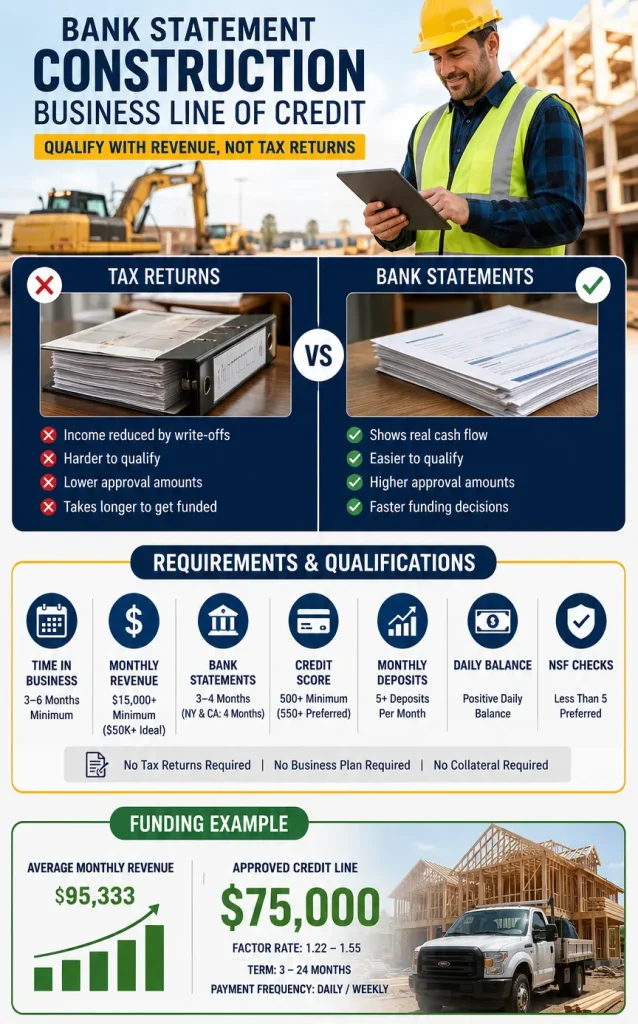
- The Revenue Floor: Your business needs a minimum of $15,000 per month in gross deposits based on your last 3 to 4 months of bank statements, with 4 months required for NY and CA.
- The 5-Deposit Rule: You must show a minimum of 5 or more deposits per month to prove stable cash flow and ongoing project activity.
- Banking Health: Underwriters look for positive daily balances and 5 or fewer NSF charges per month. Excessive NSFs of 10 or more can lead to a decline.
- The 550 FICO Floor: Minimum credit starts at 550 FICO, but higher scores can unlock better rates, stronger terms, and higher credit limits.
Revenue Requirements and Approval Amount
Your business will need a minimum of $15,000 per month in gross deposits in order to be considered for qualification. Lenders focus on the last 3 to 4 months of your business bank statements rather than on the last 2 or 3 years of your tax returns and personal credit. Your approval is based around the average of your last 3 to 4 months of gross deposits less any existing unsecured loans. Underwriters focus on 4 months for borrowers in NY and CA.
For example:
- Month 1: $96,000
- Month 2: $108,000
- Month 3: $94,000
- Average: $99,333
In this scenario, a contractor may qualify for a revolving line of credit near the average monthly deposit amount, subject to underwriting guidelines and existing debt obligations.
Deposit Frequency
We require that your business has a minimum of 5 deposits or more per month. Consistent regular deposits shows that your business has ongoing projects with recurring monthly revenue as well as stable cash flow. Anything less than 5 deposits per month may result in non approval.
Banking Activity Requirements
You must demonstrate responsible cash flow management. Your business should have positive daily as well as beginning and ending balances with minimal NSF charges. Underwriting looks for 5 or less NSF charges per month. Those with more than 5 NSF charges in any given period may pay higher financing charges while excessive NSF charges of 10 or more may result in non approval.
Time in Business
In order to apply for a bank statement line of credit for contractors your business must be at least 6 months or older. Those with two or more years of operating history may be eligible for better rates and terms.
Credit Requirements
You can still be eligible to apply for a no doc bank statement contractor line of credit with a minimum FICO score of 550. Those with lower credit scores may face more stringent requirements and more expensive financing charges. Stronger credit scores can unlock better rates, terms as well as higher credit limits.
Existing Lines or Positions
You may still qualify if you currently have other business loans or financing obligations. Lenders compare your outstanding balances to your average monthly deposits to determine eligibility. If existing debt exceeds your monthly revenue, your business may be considered overleveraged, which can reduce approval amounts or result in a decline.
Benefits of a Bank Statement Line of Credit for Contractors
Key Takeaways
- Focus on Revenue, Not Write-Offs: Qualification is based on your gross income and monthly bank deposits, not your year-end net income after deductions.
- Protect Your Tax Strategies: You can still qualify for maximum funding even if equipment purchases, depreciation, and write-offs make your tax returns look less than desirable.
- Fast-Track Funding: Get access to working capital in 24 to 48 hours, bypassing the weeks or months of waiting required by traditional bank committees.
- Minimal Documentation Required: Skip the audited financial statements and property appraisals. All that is required to apply is a completed application and your last 3 to 4 months of business bank statements.
No Tax Returns Required
A bank statement line of credit for contractors differs from a traditional construction company line of credit. A traditional line of credit from a bank requires extensive documentation such as the last two years of business and personal tax returns. This can become problematic for a construction company as owners typically reduce taxable income with other expenses such as equipment purchases, depreciation, and other deductions. These strategies can lower your taxes but make it more difficult to qualify for bank or other traditional type loans.
A bank statement credit line for contractors focuses on your gross income and cash flow management instead of tax returns. This allows your business to qualify based on revenue and your ability to repay the loan. Since your approval is based on your bank deposits, you might still be able to qualify for a larger amount, even though your tax returns are less than desirable.
Faster Approvals Than Traditional Banks
An unsecured bank statement credit line can be in your bank account in 24 to 48 hours, sometimes even less. Bank loans require extensive documentation such as personal and business tax returns as well as bank statements, audited financial statements, or even property appraisals. This process can take weeks, sometimes months for final approval and funding.
An unsecured construction company credit line only requires a completed credit application and the last 3 to 4 months of business bank statements. You can even be funded right away so long as your business meets minimum requirements and documentation is submitted right away. Access to quick financing can help your business cover expenses such as payroll, materials, or other business-related expenses.
Common Uses for a Bank Statement Construction Business Line of Credit
Key Takeaways
- Bridge Extended Payment Cycles: Eliminate cash flow gaps caused by Net 30, 60, and 90-day terms on commercial and government contracts.
- Fund Upfront Project Costs: Cover recurring overhead like weekly payroll, payroll taxes, and workers’ comp insurance while waiting for final project payouts.
- Lock In Volume Pricing: Use revolving funds to buy materials like lumber, copper wire, and fixtures in bulk to secure lower supplier pricing.
- Eliminate Job Downtime: Access quick capital to handle high-cost equipment rentals, skid steers, and roll-off dumpsters across multiple active jobsites.
Cover Payroll While Waiting on Customer Payments
Construction company owners are often bidding on commercial and government projects. Many of these projects are issued with purchase orders that are paid once the project is completed. In the meantime, your business is faced with recurring expenses such as payroll, payroll taxes, as well as workers’ compensation insurance. A bank statement credit line for your construction company can help cover these expenses while waiting on payment.
Purchase Materials Before Project Funds Arrive
A bank statement working capital credit line can also be used to buy materials ahead of time. You can use your funds to finance purchase orders or even make bulk purchases in order to take advantage of volume pricing. A revolving credit line can provide you with the liquidity needed to cover expenses like 2×4 lumber, drywall, copper wire, plumbing fixtures, or other job-related needs. Start your projects on time and keep crews moving without waiting for critical supplies.
Handle Equipment Rentals
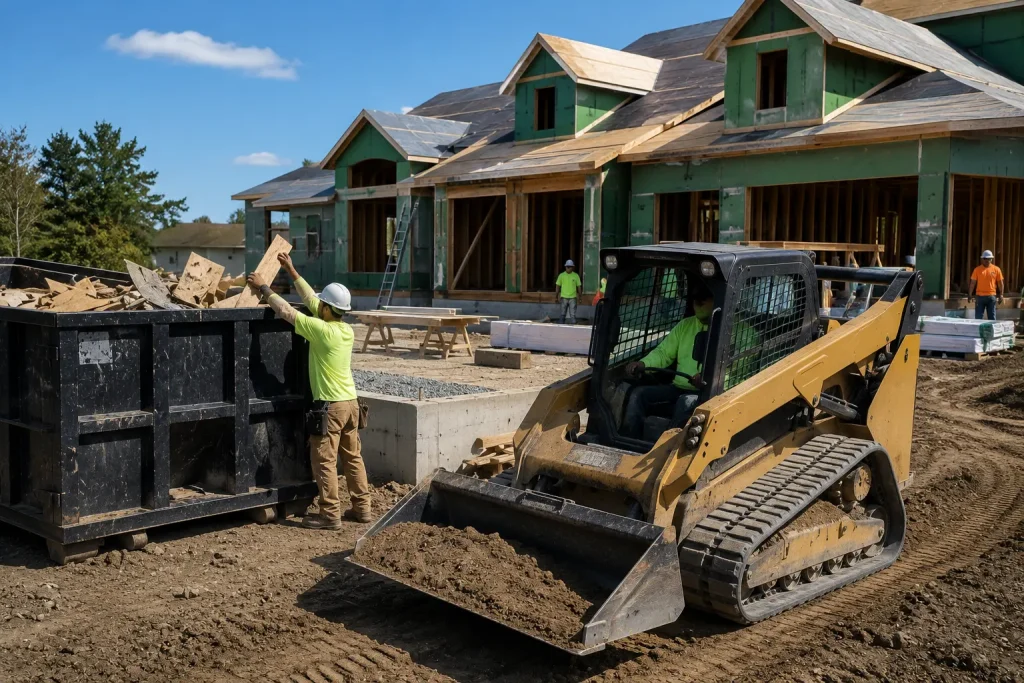
Equipment rental can become very expensive, especially when working on multiple jobs at once. A 25-yard dumpster can cost $450 for a four-day rental. These costs can add up fast when managing several sites simultaneously. Apply for a no-doc contractors line of credit to cover these expenses when you need it most. Whether it’s an excavator, a skid steer, or a roll-off dumpster, access to working capital can help your business avoid costly downtime and missed deadlines.
Manage Net 30, 60, and 90-Day Payment Cycles
Many commercial, government, and general contractor projects operate on extended payment terms. A bank statement construction business line of credit helps bridge the gap between project expenses and customer payments. Use your no-doc contractors credit line when receivables exceed cash on hand to pay suppliers, cover operating expenses, and pursue new projects without being limited by slow-paying customers.
Construction Trades That Commonly Use Bank Statement Credit Lines for Contractors
Key Takeaways
- General Contractors: Keep multiple jobsites moving forward by covering weekly payroll, material costs, and equipment rentals like Bobcats while waiting for owner draws.
- Roofing & HVAC: Lock in volume material discounts on Owens Corning shingles or stock up on R32 refrigerant before peak seasonal demand and manufacturer price hikes.
- Electrical & Plumbing: Bridge the gap when your cash flow and profit margins are locked up in construction retainage or waiting months for a Certificate of Occupancy.
- Landscaping & Hardscape: Secure front-end funding to purchase nursery stock, mulch, stone, and irrigation supplies during peak spring and summer growth cycles.
General Contractors
General contractors utilize a bank statement credit line for a variety of critical operations, including weekly payroll, covering material costs, or handling equipment rentals like a Bobcat or skid steer. Access to revolving working capital keeps your job sites moving forward smoothly instead of grinding to a halt while you wait for project draws to clear.
Roofing Contractors
A revenue-based line of credit for roofing contractors is ideal for buying materials like Owens Corning shingles and underlayment in bulk. Having liquid cash allows you to stock the best materials early or secure your inventory before the next manufacturer price increase hits, effectively hedging your project margins.
HVAC Contractors
HVAC contractors frequently use a revolving credit line to stock up on inventory and R32 refrigerant before the busy summer rush hits. This extra liquidity protects your cash reserves when you are forced to carry high equipment overhead while waiting on Net 30, 60, or 90-day commercial payments.
Electrical Contractors
Electrical contractors must often wait months to receive final payment while waiting for a project to get a Certificate of Occupancy. An unsecured credit line designed for electricians helps bridge that financial gap between upfront project expenses, specialized wire or panel purchases, and the final customer sign-off.
Plumbing Contractors
Plumbing firms face similar cash flow strains when dealing with long project timelines. A dedicated credit line for plumbers can be deployed to cover payroll and materials when your profit margins are locked up in construction retainage payments or waiting on a final building inspection.
Landscaping Contractors
Landscaping contractors rely on bank statement lines of credit to purchase plants, mulch, stone, irrigation materials, and heavy equipment ahead of seasonal surges. Additional liquidity ensures you can support multiple large-scale residential or commercial projects during peak growing seasons and periods of rapid growth.
How to Apply for a Bank Statement Construction Line of Credit
Key Takeaways
- The Paperwork Checklist: To get started, you only need to submit a basic online form along with your last 3 to 4 months of business bank statements.
- State Lookback Variations: Contractors operating in New York and California must provide a full 4 months of bank statements to fulfill state commercial financing disclosures.
- Traditional Accounts Required: Underwriters only accept statements from traditional business bank accounts. Funds sitting in third-party processors like PayPal, Stripe, or Bluevine do not qualify.
- The Underwriting Verification: Expect a standard background check through DataMerch for past commercial defaults and a live look via DecisionLogic to verify your real-time month-to-date balances.
Submit Credit Application
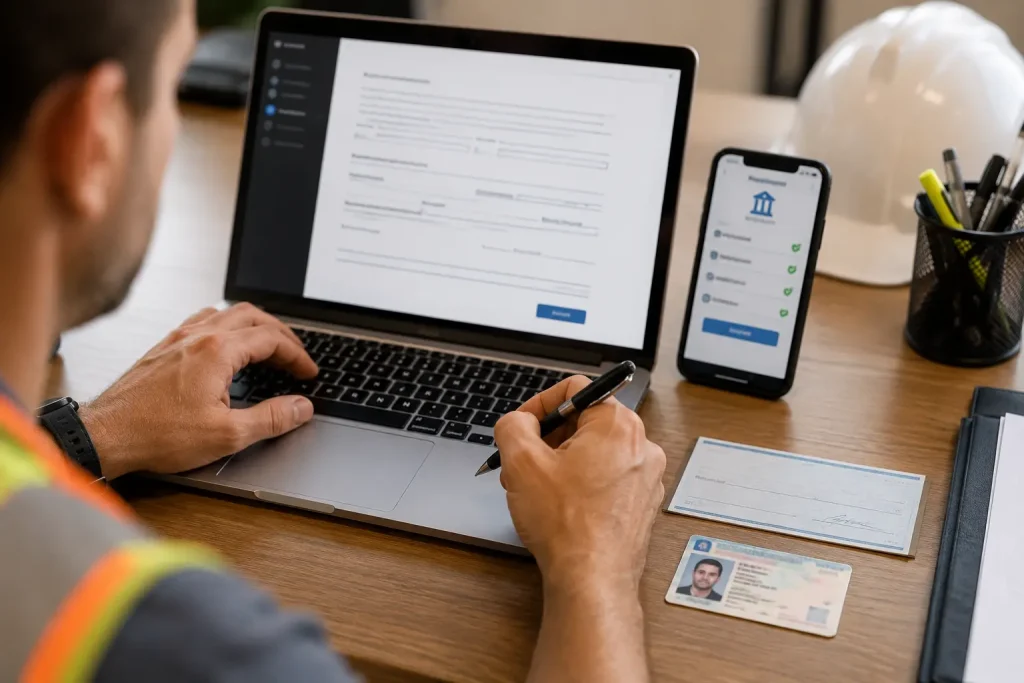
In order to apply for a bank statement line of credit for contractors you will need to fill out the application form online. You will need to fill out basic information such as your business and personal name, time in business, revenue, federal EIN number, as well as your social security number in order to get started.
Submit Business Bank Statements
You will also need to submit the last 3 to 4 months of your business bank statements along with the completed credit application. Borrowers in NY and CA must submit 4 months of statements to satisfy commercial financing disclosure requirements. Statements from third-party processors such as PayPal, Stripe, or Bluevine will not be accepted. You will need to transfer the funds into a traditional business bank account.
Receive Pre-Approval Offer
You will receive a same day pre-approval offer so long as your business meets the minimum requirements. Your pre-approval offer will include the loan amount, factor rate, and payment schedule. You will be notified as well if your business does not meet the requirements. Those who have been denied can feel free to apply again in 90 days.
Sign Documents
Once the terms are agreed upon, a formal loan contract will be prepared. This document can be signed electronically through platforms like DocuSign for a faster process. Along with the signatures, a copy of the owner’s state-issued ID and a voided check for the business must be uploaded, and depending on the specific file, 1040 tax returns or incorporation documents might be required as well.
Final Underwriting Review
The application will then move into the final underwriting stage once all documents have been submitted. Underwriting will check with DataMerch to see if you have any defaults with your current or other businesses in the past. Your lending activity is tied to your social security number as well as your EIN number.
DecisionLogic Bank Verification
You will also be asked to link your bank account via DecisionLogic. This gives underwriting live data from the current month, which helps confirm that revenue is steady and no existing debts went undisclosed. Any other unsecured loans recently taken that have not been disclosed can result in your loan being repriced or denied altogether.
Merchant Interview
Next, a brief phone conversation with the owner is required, during which the analyst will inquire about how the credit line will be used. This helps confirm that the funds are indeed intended for business uses rather than personal needs, which will lead to a rejection of the application.
Final Funding
After successfully completing the interview, the money is cleared for immediate release. Wire-transferred funds usually arrive within the same day—if wired before 4:00 PM ET—while an ACH transfer can take up to two days to fully clear into the account.
Can Contractors Qualify for a Bank Statement Line of Credit With Bad Credit?
Key Takeaways
- The 550 FICO Floor: You can secure a bank statement line of credit with a credit score as low as 550 FICO, bypassing traditional bank requirements.
- Cash Flow Over Credit: Alternative underwriters prioritize your real-time revenue and cash flow metrics over past personal credit hiccups.
- Bad Credit Pricing Reality: Lower credit profiles typically start with a 1.40 factor rate or higher and may require a daily repayment structure.
- Path to Better Terms: Successfully paying down your initial line builds a positive track record, unlocking lower rates and longer terms on your next position.
Unfortunately, bad things happen to good people. Life events like divorce or medical injuries can severely drag down your personal credit. But in the alternative commercial finance space, a FICO score as low as 550 doesn’t lock you out.
Traditional banks and SBA lenders will bury you in paperwork, relying entirely on tax returns and immaculate credit history to judge your worthiness. Alternative lenders look at the bigger picture: your last 3 to 4 months of business bank statements and your day-to-day cash flow. If your construction company pulls in at least $15,000 in gross monthly deposits, shows 5 or more distinct customer transactions a month, and keeps a healthy average daily balance, you are well within the strike zone for funding.
How Bad Credit Affects Approval Terms
A bank statement line of credit works like most alternative financial products—the stronger your credit, the cheaper the money. If you are coming to the table with a lower score, you can still get funded, but you have to expect higher factor rates.
For credit-challenged borrowers, those factor rates typically start around 1.40 and scale up based on risk. Depending on your cash flow consistency, lenders may also require a daily or weekly payment structure to mitigate that risk. Think of this initial line as a stepping stone. Once you prove you can manage the repayments responsibly, you’ll unlock the leverage needed to secure larger credit lines, longer terms, and lower rates on your next position.

Frequently Asked Questions (FAQ)
Can I qualify for a bank statement line of credit without providing tax returns?
Yes. You can apply without tax returns for credit lines up to $150,000. For most approvals, all we need is a completed application and your last 3 to 4 months of business bank statements.
How much monthly revenue do I need to qualify?
FlexLend Capital requires a minimum of $15,000 in consistent monthly revenue. Keep in mind that higher average deposits not only improve your approval odds, but they also unlock larger credit limits.
Can I get approved if my credit score is only 550?
Yes. You can qualify for a construction line of credit with a FICO score as low as 550. However, pricing is risk-based—lower scores carry higher financing costs, while stronger credit profiles secure more favorable rates.
How much can I qualify for?
Your borrowing capacity is tied directly to your cash flow. We determine your maximum credit limit by averaging your last 3 months of gross deposits, factoring in any existing debt positions.
How fast can I get funded after applying?
Most files are funded within 24 to 48 hours of submitting an application and bank statements. If all requirements are met early in the day, same-day funding is absolutely possible.
Can I use the funds for payroll, materials, and equipment rentals?
Yes. Capital can be deployed for any legitimate business expense—including weekly payroll, material orders, equipment rentals, taxes, and project mobilization. The only restriction is that the funds cannot be used for personal expenses.
Can I still qualify if I already have another business loan?
Yes, you can still secure a working capital line of credit even if you have an existing position, provided your current cash flow and monthly revenue can comfortably support the additional payment.
What documents do I need to apply?
To get started, you will just need a completed application, your last 3 to 4 months of business bank statements, a valid driver’s license, and a voided business check. If anything else is needed, our underwriting team will let you know.
Author Bio:
Robert “Todd” Holliday is a construction financing specialist with over two decades of combined experience in the construction and alternative lending sectors. Since 2020, he has facilitated millions of dollars in capital for contractors across the U.S., helping them navigate the complex cash flow cycles of the modern industry. As the former founder of ShadeIt, LLC (2004–2005), a commercial and residential tension shade fabricator, Todd possesses the unique “boots-on-the-ground” perspective required to understand the real-world financial pressures of materials, payroll, and project delays. He now leverages that expertise to bridge the gap between construction firms and the best available 2026 funding options.
Financial Disclaimer
The information provided in this guide is for educational and informational purposes only and does not constitute professional financial, legal, or tax advice. Loan rates, terms, and SBA program guidelines mentioned are based on early 2026 market projections and are subject to change without notice based on lender criteria and Federal Reserve policy. Qualification for any construction loan product depends on individual business factors, including credit score, annual revenue, and time in business. We recommend consulting with a certified financial advisor or a qualified tax professional before entering into any credit agreement.