
Key Takeaways
- Industry Challenges: Seasonality, cost overruns, and a concentrated customer base frequently cause cash flow gaps for construction companies.
- Alternative Financing Exists: Specialized alternative lenders look past low credit scores, often down to 500, if a business shows healthy cash flow and meets minimum monthly revenue requirements, typically $15,000 or more.
- Risk-Based Pricing: While funding is accessible, lower credit scores generally result in higher factor rates and shorter repayment terms.
Construction Industry Cash Flow Challenges and Credit Problems
The construction industry comes with many challenges when applying for a bad credit construction company loan. The construction business can be seasonal. There are cost overruns, job delays, material defects, and other factors that determine how much or when a customer pays. Construction companies also tend to have a less diversified customer base, which can create cash flow issues and hurt daily account balances. Other challenges, such as government regulations and new tariffs affecting material costs, can place additional strain on working capital.
Why Many Construction Company Owners Have Bad Credit
It is not uncommon for a construction company owner to have bad credit. Unfortunately, bad things happen to good people. Contractors sometimes go unpaid by general contractors, real estate developments can fail, and HVAC, electrical, plumbing, roofing, and other trade contractors, along with their suppliers, may never receive payment. During the 2008 financial crisis, thousands of construction-related businesses were forced into bankruptcy through no fault of their own. In my 25 years of experience, I have seen many businesses close because a major customer failed to pay, including my own.
How Alternative Lenders Approve Bad Credit Construction Loans
Fortunately, specialized bad credit financing is available for construction company owners. Alternative lenders specialize in this type of financing and offer funding to contractors with credit scores as low as 500. Rather than focusing primarily on your credit score, they evaluate your business cash flow and monthly revenue. Most lenders require at least $15,000 in monthly business revenue to qualify.
How Credit Scores Affect Loan Pricing and Terms
Although bad credit financing is available, risk is reflected in the loan pricing. Borrowers with lower credit scores generally receive higher factor rates and shorter repayment terms. Contractors with credit scores between 580 and 620 typically qualify for more favorable pricing and larger funding amounts. Even so, access to bad credit construction company loans can provide the working capital needed to keep projects moving and your business operating smoothly.

What is a Bad Credit Construction Company Loan
Key Takeaways
- Business vs. Project Funding: This is a business operational loan used for payroll, materials, and working capital, distinct from a “bad credit construction loan” meant for building physical real estate.
- Speed and Convenience: Provided primarily by alternative online lenders, these loans circumvent strict bank regulations, requiring minimal documentation (3–4 months of bank statements) for 24-hour funding.
Bad Credit Construction Company Loans vs. Construction Loans
A bad credit construction company loan should not be confused with a bad credit construction loan. Construction loans for borrowers with bad credit are designed for individuals or developers who need financing to build a real estate project. This could include a home, office building, warehouse, storage facility, barn, or other construction project that ultimately becomes a tangible asset.
How Construction Company Owners Use These Loans
This guide is intended for construction company owners with bad credit who need business financing. A bad credit construction company loan is designed to cover business operating expenses rather than real estate development. Contractors commonly use these loans for payroll, materials, inventory, working capital, equipment purchases, and other day-to-day business expenses.
Why Alternative Lenders Approve Bad Credit Borrowers
Bad credit construction company loans are primarily offered by online alternative lenders. These lenders are not subject to the same underwriting requirements as traditional banks, allowing them to approve loans more quickly and with less documentation. While banks may also offer business loans to contractors with bad credit, they typically require collateral and a much longer approval process.
Documentation Required for Fast Approval
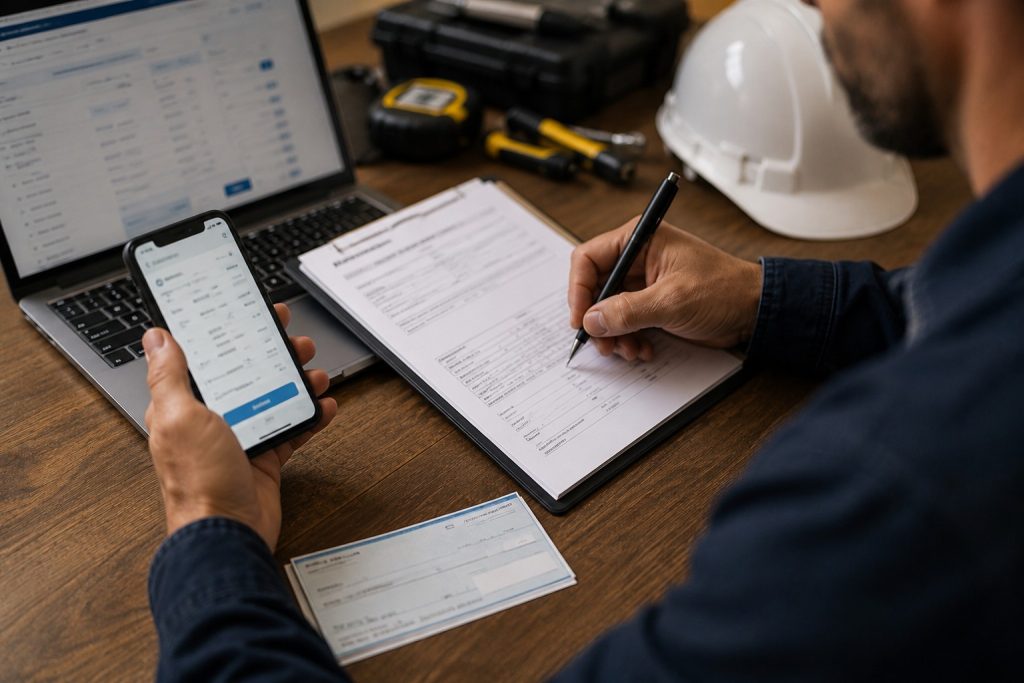
Alternative lenders streamline the application process by requiring only a completed credit application and the last three to four months of business bank statements to begin final underwriting. Before funding, borrowers are typically asked to provide a valid driver’s license and a voided business check. In many cases, qualified construction companies can receive funding within 24 hours.

Why Construction Companies Are Considered High Risk
Key Takeaways
- Volatile Market Forces: Underwriters cite thin margins, fluctuating material costs (like the 50% steel tariff), labor shortages, and seasonality as major risk flags.
- Unpredictable Cash Flow: High operational overhead combined with sporadic, milestone-based customer deposits makes cash reserves easy to deplete.
- Completion & Litigation Risks: The purchase-order nature of the work means payment delays, weather holdups, or specification disputes can suddenly trigger massive financial losses.
Tight Margins, Material Costs, and Labor Shortages
There are multiple reasons construction companies are considered high risk by underwriters. Profit margins are often thin, customer concentration is high, material prices fluctuate, and seasonality creates unpredictable revenue. Rising material costs can significantly reduce profitability. For example, steel tariffs and other market conditions can increase project costs after a bid has already been awarded. Labor shortages also continue to affect the industry, making it more difficult and expensive to complete projects on time. These factors increase the overall financial risk associated with construction businesses.
Cash Flow Challenges and Irregular Customer Payments
Cash flow is another major concern for lenders. Unlike retail businesses that receive frequent customer payments, construction companies often rely on milestone or project-based payments from a relatively small number of customers. This makes cash flow less predictable. At the same time, contractors must continue paying payroll, insurance, equipment expenses, and suppliers regardless of when customers pay. High operating expenses combined with irregular deposits can quickly reduce available cash reserves, making construction companies appear riskier during underwriting.
Project Delays and Completion Risks
Construction projects also carry significant completion risk. Contractors frequently purchase materials and hire labor before receiving final payment. Weather delays, change orders, material defects, permitting issues, and inspection failures can postpone project completion and delay customer payments. Since many contracts are paid only after specific milestones or final completion, even minor setbacks can create substantial cash flow problems.
Litigation and Financial Losses
Construction disputes can also result in costly litigation. Specification disagreements, workmanship claims, contract disputes, or unexpected project changes can lead to delayed payments or significant financial losses. These risks are well understood by lenders and underwriters, which is why financing a construction company often requires stronger cash flow, higher revenue, or additional risk-based pricing compared to many other industries.
What Is Considered “Bad Credit” for a Construction Business?
Key Takeaways
- Score Tiers: Scores below 650 drop borrowers into “C” or “D” paper categories, pushing factor rates to 1.39 or higher.
- Factor Rates vs. Interest: Instead of compounding interest, these loans use a fixed multiplier (e.g., borrowing $100,000 at a 1.45 factor rate means a flat $145,000 payback).
- Shorter Terms: Lower credit profiles typically limit repayment windows to a brief 6–9 month range, though early payoff discounts may be available.
Credit Score Tiers for Construction Company Loans
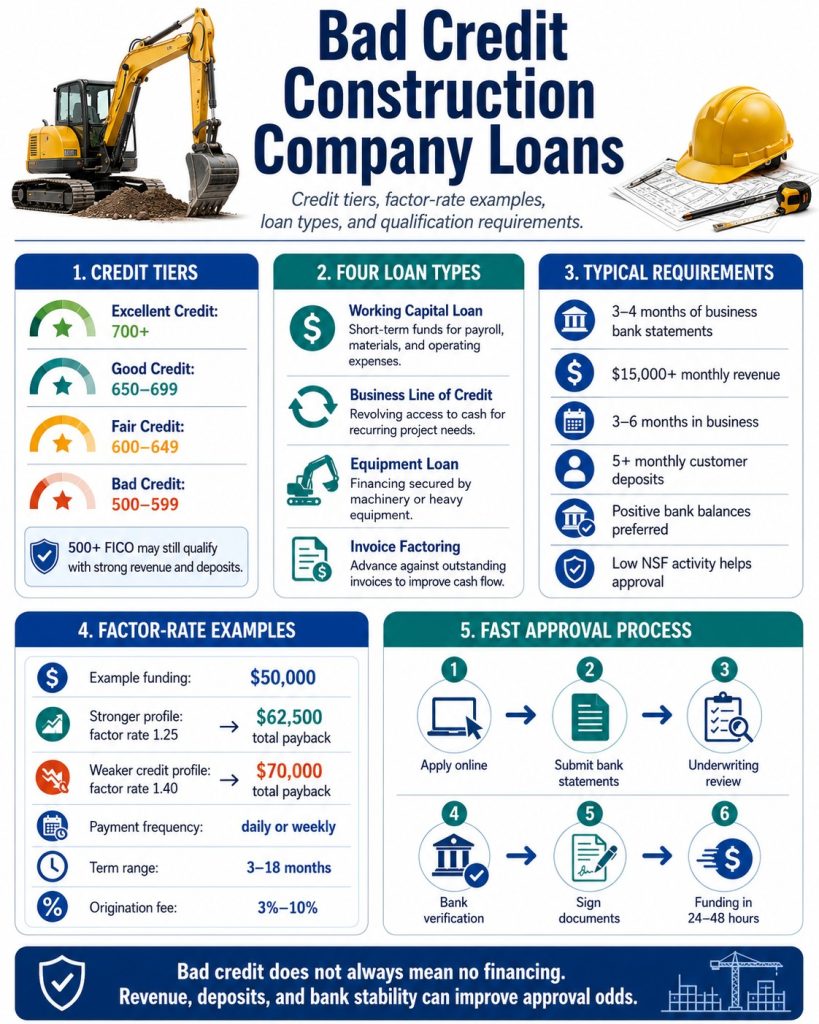
Anything below a 650 credit score is generally considered bad credit. Most “B” paper lenders look for a credit score of 650 or higher, while “A” paper lenders typically require scores of 700 or better. Borrowers with stronger credit usually qualify for lower factor rates, often starting around 1.29, depending on factors such as daily bank balances, cash flow, and payment frequency. If your credit score falls below 650, you will generally be placed into the “C” or “D” paper category, where factor rates typically begin around 1.39 or higher.
How Factor Rates Work
Factor rates differ from traditional interest rates. Interest accrues over time, while a factor rate is a fixed multiplier applied to the original loan amount. For example, a construction company borrowing $75,000 with a 1.29 factor rate will repay a total of $96,750. A contractor with lower credit may receive a 1.45 factor rate, meaning a $100,000 loan would have a total repayment of $145,000. Because the total repayment amount is known upfront, borrowers know exactly what they will owe before funding.
Early Payoff Discounts
Many alternative lenders offer early payoff discounts that can reduce the overall cost of financing. These discounts are generally largest during the early months of the loan and gradually decrease as the loan approaches maturity. Your loan agreement will specify whether the discount is applied to the remaining balance or the financing charges.
How Credit Affects Loan Terms
Credit scores also influence repayment terms. Borrowers with excellent credit may occasionally qualify for terms as long as 36 months, although this is uncommon. Most construction company owners with “C” or “D” credit profiles are approved for repayment terms ranging from six to nine months. Higher credit scores generally result in lower factor rates, longer repayment periods, and more favorable loan terms.

Can You Get a Loan for a Construction Company With Bad Credit?
Key Takeaways
- Financing is Attainable: While traditional banks reject low-credit owners without heavy real estate collateral, online private lenders actively fund “C” and “D” tier businesses.
- Streamlined Verification: Rather than requiring deep financials (P&Ls, tax returns), alternative lenders prioritize the last 3–4 months of bank statements to gauge cash flow.
- Cash Flow is King: Demonstrating consistent daily bank balances and healthy monthly ending revenue is the primary way to secure an approval.
Traditional Banks vs. Alternative Lenders
Yes, it is possible to get a loan for a construction company with bad credit. Traditional banks rarely finance borrowers with poor credit unless they can pledge valuable collateral, such as commercial or residential real estate. This makes it difficult for many contractors to qualify for larger loans, such as a $150,000 construction company loan. Alternative lenders, however, are not subject to the same underwriting guidelines as traditional banks. Many private lenders offer financing specifically designed for “C” and “D” paper borrowers with less-than-perfect credit.
Why Alternative Lenders Approve Loans Faster
Traditional bank loans require extensive documentation, including tax returns, profit and loss statements, financial statements, and, when collateral is involved, property appraisals. This process can take weeks or even months. Alternative lenders have streamlined underwriting and typically require only a completed credit application and the last three to four months of business bank statements. Tax returns are generally requested only for larger loan amounts, typically exceeding $150,000. As a result, qualified construction companies can often receive funding within 24 hours.
Why Fast Funding Matters for Construction Companies
Speed is critical in the construction industry. Material prices can increase between the time a contract is awarded and when supplies are purchased. Having fast access to working capital allows contractors to purchase materials immediately, secure labor, and keep projects moving without costly delays.
Cash Flow Is More Important Than Your Credit Score
Cash flow is one of the most important factors underwriters evaluate when reviewing a bad credit construction company loan application. Many business owners have damaged credit because of circumstances beyond their control, but consistent revenue demonstrates the ability to repay financing. Positive daily bank balances, healthy monthly ending balances, and steady business deposits provide lenders with confidence that the business can support the loan, even if the owner’s credit score is less than ideal.
Types of Bad Credit Construction Company Loans
Key Takeaways
- Short-Term Working Capital Loans: Ideal for rapid overhead needs; repayment relies on daily or weekly automatic drafts over a 3–9 month span.
- Lines of Credit (LOC): Unsecured alternative LOCs require a 550+ credit score and offer revolving access, though they carry higher fees and shorter terms than bank lines.
- Equipment Loans: Secured directly by the heavy machinery being purchased (acting as collateral), opening access to credit scores down to 500 with a 10%–30% down payment.
- Invoice Factoring: Businesses sell their outstanding customer invoices to a factoring company at a small discount (around 3%) to unlock immediate working capital.
Millions of people have had credit issues at some time in their lives HVAC, Electrical, Plumbers, Roofing, Landscaping, Drywall as well as General Contractors are no exception to the rule. Construction company loans for bad credit are available for those who have credit challenges in the past. There are multiple options available such as short term working capital loans, lines of credit, equipment loans as well as invoice factoring.
Short-Term Working Capital Loans
Short-term working capital loans can be used for any needs such as payroll, inventory, working capital, advertising, materials or other business related expenses. These loans are available with terms up to 9 months for bad credit. The average approval is usually around 6 months and in some cases can be as short as 30 days for a starter loan. Starter loans are typically given to those that have past defaults with another unsecured lender. Construction company loans for bad credit are also more expensive. Expect to pay a factor rate of 1.39 or higher. In some very high risk cases I have seen up to 1.55. Short-term working capital loans for bad credit also usually have daily payments. In some cases weekly payments are available. Monthly payments are usually never granted. The approval size is based on your recent cash flow or last 3 to 4 months bank statements. The underwriter will average the last 3 months and make a determination from there.
Line Of Credit
A line of credit is a financial instrument similar to a credit card. You are given a credit limit and draw cash up to the limit amount. You can then make a monthly interest payment and pay it down as needed. Traditional banks issue lines of credit to businesses for cash flow purposes. Most unsecured lenders require a 550 or better credit score to qualify for an unsecured line of credit. Alternative lenders look at these as revenue-based lines of credit. Unsecured loans are also more expensive than a traditional collateralized loan from a bank. Banks require a credit score of 680 or better. In order to go to a bank, the only option for a construction company owner with bad credit would be to use collateral as a means by which to secure the LOC.
Terms are usually short-term for an unsecured line of credit for a construction company owner with bad credit. These terms are usually around 12 months, give or take. Payments are structured weekly or daily and will always cover interest and principal. The line can be paid down and drawn upon again as long as business conditions remain the same. A secured line of credit from a bank will have the same terms as any traditional bank line of credit; however, it is more difficult to obtain.
Equipment Loans
Equipment loans for construction equipment such as excavators, bulldozers, cranes, skid steer loaders, backhoe loaders or other construction related equipment is available to those who have bad credit. Specialized bad credit equipment loan lenders look for a credit range between 500 and 620. The loan is collateralized by the equipment and subject to repossession for non payment.
Other requirements are 1 or more years in business, 3 to 6 months bank statements and any appropriate business licenses if requested. Bad credit construction company equipment loans can run as high as 20% a year and in extreme cases 34% a year. Terms are usually around 36 to 48 months. Specialized equipment loans can go as high as 84 months. Payments are typically monthly but may vary on a case-by-case basis. Buyers must also purchase from an equipment dealer who must install GPS tracking. Purchases from private individuals are rarely approved. Down payments usually range from 10% all the way up to 30% or more.
Invoice Factoring
Invoice factoring is a way for a construction company owner to recoup unpaid customer invoices. In some cases, customers may take 30, 60, or even 90 days to pay an invoice from the time it is received. This can cause significant cash flow issues for any business owner, regardless of credit. Some construction company owners may opt to sell their invoice to a factor at a discount. This “discount” is the fee that the factor charges for its services. This fee is calculated as a percentage of the total invoice value, usually around 3%.
A factor allows a business owner to issue an invoice and receive immediate payment. The factor then buys the invoice, less the discount amount, and receives payment from the original customer. Factors typically pay 90% of the invoice upfront, and the remaining 10%, less the discount, is paid once the factor receives payment.
Factoring as it is called is a great way for a bad credit construction business owner to recoup working capital and profit. This type of arrangement quickly frees up money to be reinvested in other projects.

Minimum Lender Requirements for a Bad Credit Construction Company Loan
Key Takeaways
- Bank Limits: Banks strictly require property/stock collateral up to 80% LTV, offering very little flexibility for impaired credit.
- Alternative Base Criteria: Online Merchant Cash Advance (MCA) and unsecured lenders trade high credit scores for rapid, revenue-based parameters.
Traditional Bank Requirements
Traditional banks or SBA loans offer very few financing options for borrowers with bad credit. In most cases, banks require valuable collateral before approving a loan. This typically means pledging real estate or marketable securities, with loan amounts generally limited to approximately 80% of the collateral’s value. If the loan goes into default, the lender has the right to foreclose on or repossess the pledged assets.
Alternative Lender Qualification Requirements
Merchant cash advance (MCA) lenders and other alternative financing companies have less restrictive underwriting guidelines than traditional banks. Instead of focusing primarily on collateral and credit scores, they evaluate your business revenue and cash flow. Most lenders require the following minimum qualifications:
- 500 credit score or higher
- Three to four months of business bank statements
- At least $15,000 in monthly business revenue
- Business tax returns for larger loan requests, typically $150,000 or more
Why Alternative Lenders Are Easier to Qualify With
Merchant cash advances and unsecured business loans are often the best financing options for construction company owners with bad credit. These programs require minimal documentation, rely primarily on recent business bank statements instead of collateral, and can often provide funding within 24 hours for qualified applicants.
How to Improve Your Approval Odds When You Apply for a Bad Credit Construction Company Loan
Key Takeaways
- Protect Bank Metrics: Maintain a positive Average Daily Balance (ADB) and strictly minimize NSF (Non-Sufficient Funds) marks. Exceeding 10 NSFs in 90 days triggers automatic declines.
- Avoid Stacking: Do not take out multiple alternative loans concurrently; real-time monitoring software will spot it and potentially flag the account for default.
- Complete Transparency: Fully disclose past business debts and defaults. Unsecured lenders utilize specialized databases like DataMerch to track historical payment defaults tied directly to your Social Security number.
Maintain Strong Cash Flow and Positive Bank Balances
Improving your approval odds is straightforward if you focus on the financial health of your business rather than just your credit score. First, make sure your business generates at least $15,000 in monthly revenue. Underwriters pay close attention to your Average Daily Balance (ADB), so maintaining positive beginning and ending balances throughout the month is critical. Consistent cash flow demonstrates your ability to handle an additional loan payment.
Minimize NSF Charges
You should also keep NSF (Non-Sufficient Funds) charges to a minimum. Ideally, your business should have none. However, most lenders will automatically decline an application if they see more than 10 NSF occurrences within a three-month period. Positive daily balances and responsible account management are two of the strongest indicators of a financially stable business.
Disclose Existing Business Loans
Be transparent about your current financing obligations. Do not attempt to hide existing business debt. Lenders understand that many construction companies have multiple financing positions, and you can still qualify if your revenue supports the additional payment. However, taking out multiple alternative loans without notifying your lender—commonly known as stacking—can create serious problems. Many lenders use real-time bank monitoring software to detect unauthorized funding and may charge stacking fees or declare your loan in default if additional financing is discovered.
Disclose Any Past Loan Defaults
A prior default on an unsecured business loan will generally prevent you from qualifying for new financing. Some borrowers choose not to disclose past defaults, but alternative lenders have access to industry databases such as DataMerch, which tracks unsecured business loan history, including defaults, payment modifications, and repayment performance. Because these records are tied to your Social Security number rather than your business entity, a default from a previous business can affect your ability to qualify for financing today. Honest disclosure helps avoid delays and prevents unnecessary issues during underwriting.

Frequently Asked Questions
What credit score is considered bad credit for an HVAC contractor loan?
Anything below a 650 FICO score is generally considered subprime. Borrowers between 620 and 650 are typically considered “C” paper, while those below 620 fall into “D” paper. Approval, pricing, and repayment terms vary based on your overall risk profile.
Can I get an HVAC contractor loan with a 500 credit score?
Yes. Many alternative lenders approve HVAC contractors with credit scores as low as 500. Instead of focusing primarily on your credit score, they evaluate your business revenue, cash flow, and recent bank statement activity.
Do I need collateral for an unsecured HVAC contractor loan?
No. Unsecured HVAC contractor loans do not require collateral. Instead, lenders generally file a UCC financing statement against the business as part of the loan agreement.
How much monthly revenue do I need to qualify?
Most programs require a minimum of $15,000 in monthly business revenue. Businesses with higher and more consistent revenue generally qualify for larger funding amounts.
How quickly can I receive funding?
Many HVAC contractors receive funding within 24 to 48 hours after submitting all required documentation and successfully completing final underwriting.
What documents are required to apply?
To begin the pre-approval process, you will typically need to submit a completed credit application and your last three months of business bank statements. Prior to funding, lenders usually request a valid driver’s license and a voided business check.
Can I qualify if I already have another business loan?
Yes. Many HVAC contractors qualify even if they have an existing business loan, provided it is disclosed during the underwriting process. Lenders generally discourage undisclosed stacking but may approve multiple financing positions when your revenue supports the additional payment.
How much can I qualify for?
Your approval amount is primarily based on your average monthly business revenue, cash flow, and any outstanding unsecured loan obligations. Businesses with stronger deposits and healthier cash flow typically qualify for larger funding amounts.
Can I get approved if I have a past default?
Generally, no. Most alternative lenders will decline applicants with a prior unsecured loan default or loan modification because this information is tied to your Social Security number and reviewed during underwriting.
Author Bio
Robert “Todd” Holliday has been in the alternative industry since 2020. He has financed multiple millions of dollars for construction businesses all over the United States. From 2004 to 2005 he ran ShadeIt, LLC, a commercial and residential tension shade structure fabricator and installer.